Dishwasher estimates differ because “not working” can mean no fill, poor wash, no drain, leak detection, heating, door/latch, user interface, inverter/pump, or control communication.
What a GE dishwasher repair costs depends on the system the diagnosis finds, whether that is drain, leak detection, water supply, heating, door hardware, or controls. The cycle stage where the problem begins is the most useful thing to tell the scheduler, because it narrows the possibilities before anyone arrives.
Dishwasher estimates differ because “not working” can mean no fill, poor wash, no drain, leak detection, heating, door/latch, user interface, inverter/pump, or control communication.
| Message or symptom | What it can point to | What you can safely check |
|---|---|---|
| C1, C3, FTD, or F56 | Drain-related messages: C1 is a pump-out over 2 minutes and C3 a failure to drain, per GE | Check the filters, drain hose, air gap, and disposer |
| H2O during a normal, AutoSense, Heavy, or Light cycle | Not enough water; GE says to check the inlet hose for kinks and the supply valve | Fully open the hot water valve under the sink |
| LEAK DETECTED | A cycle cancelled on a model with leak detection | Keep the power disconnected until it is repaired |
| C6 | Water too cold; GE says it needs at least 120F | Check the hot water supply |
| Standing water in the tub | A drain restriction, a clogged sink drain, or a disposer | Check the filters and the sump for large food pieces |
The exact model, failed system, part availability, installation access, and whether a return visit is required all affect the quote. Leave the filters, hose, and drain path checked before the visit so the quote reflects the appliance and not a clog that was fixable at home.
GE dishwashers can use consumer messages such as `C1–C8`, `FTD`, `F56`, `H2O`, `PrS`, `LEAK DETECTED`, and model-family-specific F-codes. Some displays such as delay hours are status messages rather than repair faults. Describe the cycle stage—fill, wash, drain, heat/dry, or start/control—because that determines which technical family is relevant.
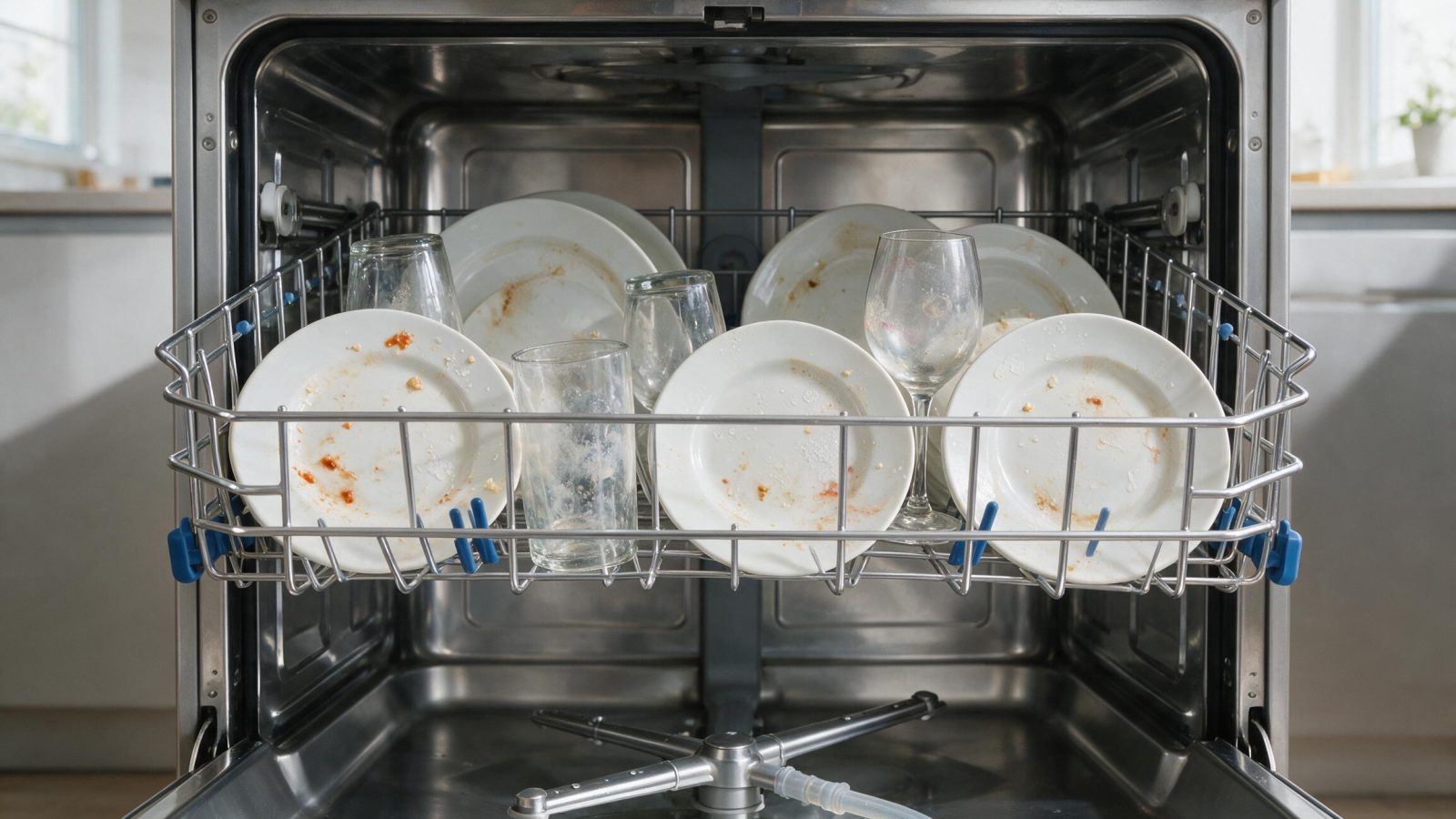
GE says to check the filters, the rear sump, the drain hose below the sink, and the kitchen sink drain before assuming the dishwasher has failed. If a disposer was recently installed or replaced, its drain plug must be removed per its installation instructions, a household issue rather than an appliance repair.
Detergent also matters. Wrong type or too much can cause over-sudsing, which can prevent proper draining, and GE says not to use drain cleaner in the dishwasher.
A useful quote should identify whether the issue is an external connection, a circulation/drain component, sensing, heating, door hardware, or controls.
A useful estimate explains what was tested, what was found, the proposed part or repair action, and any work outside the appliance repair scope.
The same dishwasher can show a drain message because of a hose, an air gap, or a sink drain just as easily as a pump. GE lists C4 as the dishwasher filling twice after a power failure, which points to a stuck float or a clogged drain or sump.
Code C3 calls for cutting power at the breaker for about 30 seconds, and unplugging for 1 to 2 minutes can clear some codes. A technician can then separate a pump or sensor concern from household plumbing, which is why the estimate may list plumbing work separately.
Compare the repair with the installed replacement cost, not only the store price. Delivery, haul-away, cabinetry, electrical or gas work, plumbing, venting, stacking, and fit can materially change the real comparison.
Leave built-in, stacked, or tightly fitted appliances installed unless the service team specifically requests access. Moving an appliance without a plan can disturb flooring, cabinetry, gas, water, drain, vent, or electrical connections and create a second problem.
The technician should reproduce the symptom or use your observations to select a narrow test path. That may involve comparing sensor readings, fan or pump commands, control output, airflow, water flow, ignition behavior, or stored diagnostics. The goal is to replace only what testing supports.
Write down:
– complete GE model number;
– exact symptom in one sentence;
– when it began;
– whether it is constant or intermittent;
– what related function still works normally;
– any displayed code/message before reset;
– any recent power, water, gas, venting, cleaning, filter, or installation event.
Do not clear codes before documenting them, do not order a part because another GE owner had a similar symptom, and do not apply one code meaning across unrelated appliance families. Some GE displays are status or operating messages rather than repair faults.
One controlled owner-level check is useful when it answers a question. Repeating resets or disassembling the appliance usually removes evidence rather than adding it.
One normal manual-approved reset can be useful after a temporary control interruption. Record the code or display state first. If the same symptom returns, repeated resets are not a repair.
Usually no. Similar symptoms can come from different components, installation conditions, or external utilities.
No. Keep homeowner checks external and model-appropriate.
No. GE lists hose kinks, air gap debris, disposer problems, and sink drain clogs among the checks. The quote should reflect what testing finds.
Fill, wash, drain, heat, and start problems involve different components. Knowing when it stops helps the technician choose a narrower test.
GE says not to. Use the filter, sump, hose, and sink-drain checks instead.
One normal manual-approved reset can be useful after a temporary control interruption. Record the code or display state first. If the same symptom returns, repeated resets are not a repair.
Usually no. Similar symptoms can come from different components, installation conditions, or external utilities.
No. Keep homeowner checks external and model-appropriate.
A GE UltraFast Combo combines washing and drying systems in one cabinet. Drain-filter issues, lint-path conditions, sensors, pumps, drive components, heat-pump drying hardware, and…
The repair scope depends on whether the washer cannot fill, drain, lock, balance, spin, or drive the basket. GE front-load, top-load, and combo platforms…
A dryer that runs poorly can have a venting problem, heating-system issue, thermistor/sensor problem, motor/blower concern, door-switch problem, supply fault, or electronic control issue.
Request a repair on our homepage booking form, or call us and we’ll help right away.