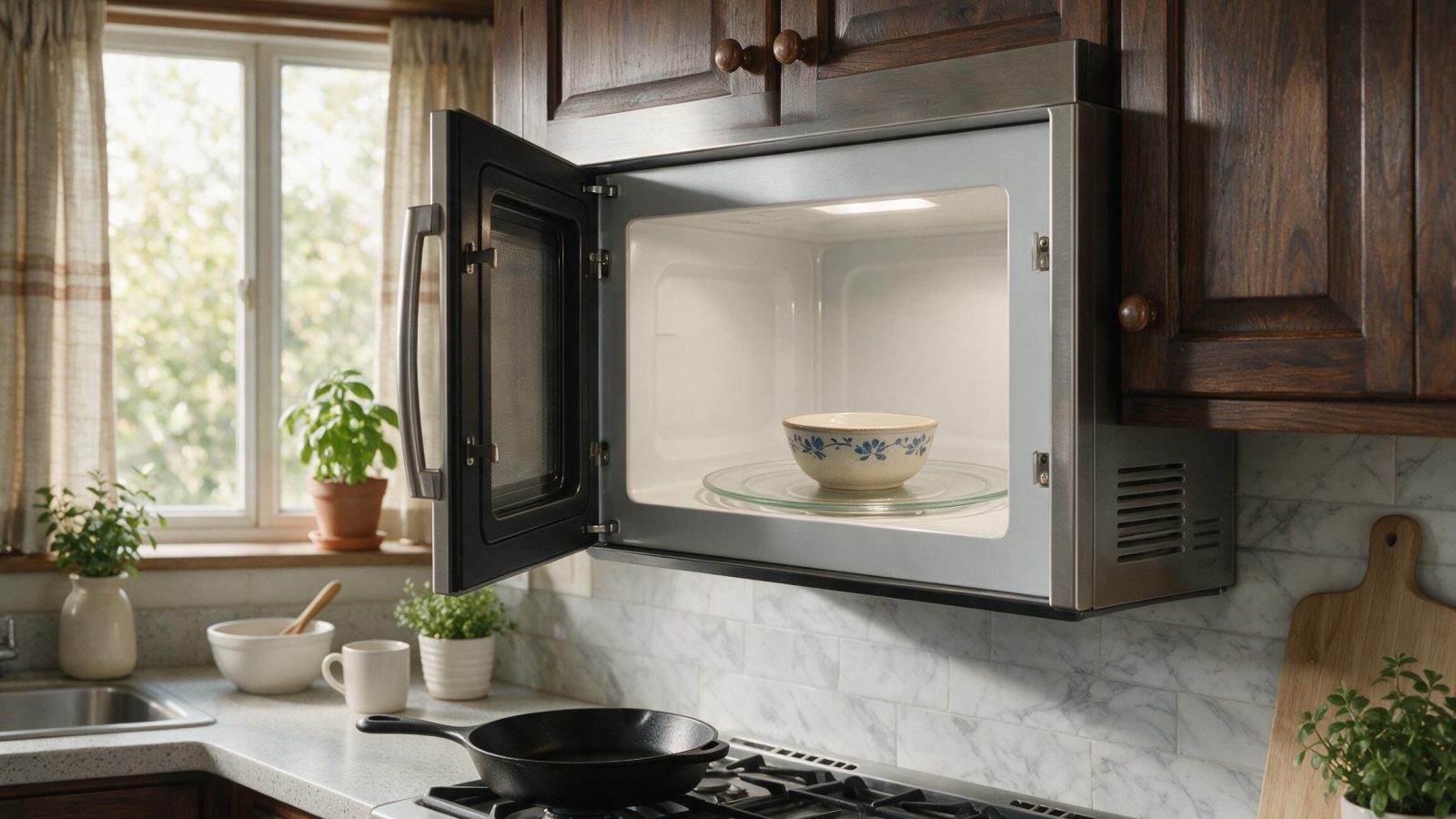
A microwave can light, run the fan, and turn the tray while failing to heat. That symptom can involve door sensing, controls, inverter/high-voltage components, magnetron-related systems, or a power condition depending…
When a GE microwave lights up, spins the tray, and runs the fan but leaves food cold, start with the two simple checks GE lists for this symptom: a timer function started by mistake, and a door that was opened and then not closed firmly. If both are ruled out, the cause sits in parts that should be left to service.
A microwave can light, run the fan, and turn the tray while failing to heat. That symptom can involve door sensing, controls, inverter/high-voltage components, magnetron-related systems, or a power condition depending on the model.
Confirm the unit is not in a demo/display mode where applicable.
| Symptom | What it can point to | What you can safely check |
|---|---|---|
| Display counts down, light and fan work, cup of water stays cool | A timer or clock function running instead of a cook cycle, or a door that did not fully engage its safety mechanisms | Cancel, choose a normal cook time and power level, then open the door and close it firmly before starting again |
| Probe message appears during a temperature cook | The cooking probe is open or not plugged in | Seat the probe correctly, or switch to a plain timed cook if the recipe allows |
| 888, 8888, or PF on the display | A message that can appear at installation or after a power outage | Let the display settle after power returns, then try a short cook with a cup of water |
| F1 or F2 on some GE microwaves | GE describes F1 as an open thermal sensor, often tied to excessive heat in the cavity, and F2 as a shorted one | Let the cavity cool, never run it empty, and leave the rest to service if the code returns |
Test one normal short heating cycle with a microwave-safe cup of water. Use a cup that is clearly microwave-safe and a fixed run time, so the result can be compared later if the symptom comes back.
The light, fan, and turntable do not need the high-voltage section that produces the heat. That is why a microwave can look completely normal while heating nothing, and why the tray turning is not a sign the heating system is healthy.
GE offers no do-it-yourself repair advice for microwaves, because an internal high-voltage capacitor can hold a charge even after the unit is unplugged. Unplugging the microwave therefore does not make the cabinet safe to open, and nothing under the outer cover is an owner task.
Note any displayed F-code, PF/power-watch message, or unusual sound before reset.
GE microwave codes such as `F1–F6`, `F10`, `Probe`, `PF`, and power-watch indications are platform-dependent. Troubleshooting must stay external; do not remove the cabinet to inspect high-voltage components. A microwave can appear to operate normally while failing to heat, so note fan/light/turntable behavior separately from heating.
Messages are easy to misread on a microwave. Probe, 888, 8888, and PF each have a specific meaning on GE models, and none of them tells you that the heating system has failed. Check the use-and-care manual for your own model before drawing a conclusion from a display.
If the microwave repeatedly runs without heating, stop at the external observations. Cabinet removal and high-voltage diagnosis belong to qualified service.
A cup of water that stays cool after a firm door close and a corrected timer setting tells you the cooking cycle is not producing heat. It does not tell you which part is responsible, because door sensing, controls, and the high-voltage path can all end in the same result.
A cup that comes out warm only after a much longer run is a different observation from one that never warms at all, and a technician can use that difference to choose where to begin. Keep the observation short and factual instead of trying to guess the part.
Record the complete model number and any displayed code before resetting power. Code meaning must be matched to the correct GE appliance family and platform.
Leave built-in, stacked, or tightly fitted appliances installed unless the service team specifically requests access. Moving an appliance without a plan can disturb flooring, cabinetry, gas, water, drain, vent, or electrical connections and create a second problem.
The technician should reproduce the symptom or use your observations to select a narrow test path. That may involve comparing sensor readings, fan or pump commands, control output, airflow, water flow, ignition behavior, or stored diagnostics. The goal is to replace only what testing supports.
Write down:
– complete GE model number;
– exact symptom in one sentence;
– when it began;
– whether it is constant or intermittent;
– what related function still works normally;
– any displayed code/message before reset;
– any recent power, water, gas, venting, cleaning, filter, or installation event.
Do not clear codes before documenting them, do not order a part because another GE owner had a similar symptom, and do not apply one code meaning across unrelated appliance families. Some GE displays are status or operating messages rather than repair faults.
One controlled owner-level check is useful when it answers a question. Repeating resets or disassembling the appliance usually removes evidence rather than adding it.
One normal manual-approved reset can be useful after a temporary control interruption. Record the code or display state first. If the same symptom returns, repeated resets are not a repair.
Usually no. Similar symptoms can come from different components, installation conditions, or external utilities.
No. Keep homeowner checks external and model-appropriate.
No. GE notes that an internal high-voltage capacitor can hold a charge after unplugging, so opening the cabinet is not a safe owner check. Stay with the door, timer, and display checks.
On GE models the Probe message means the probe is open or not plugged in during a temperature cook. Plug it in properly or run a normal timed cook, and book service if the message stays with the probe seated.
Not necessarily. The right answer depends on what testing finds and on the exact model, so a diagnosis should come before any repair-or-replace decision.
One normal manual-approved reset can be useful after a temporary control interruption. Record the code or display state first. If the same symptom returns, repeated resets are not a repair.
Usually no. Similar symptoms can come from different components, installation conditions, or external utilities.
No. Keep homeowner checks external and model-appropriate.
On supported GE washers, an H2O SUPPLY message points the troubleshooting path toward water delivery or water-level sensing. Start outside the cabinet before assuming…
A GE dryer that starts and then stops can be reacting to overheating, restricted airflow, door-switch interruption, motor protection, supply conditions, sensing, or control…
A dry or slow dispenser can be caused by the household supply, filter, tubing, frozen sections, door/interlock conditions, valve operation, paddle switch, or controls.…
Request a repair on our homepage booking form, or call us and we’ll help right away.