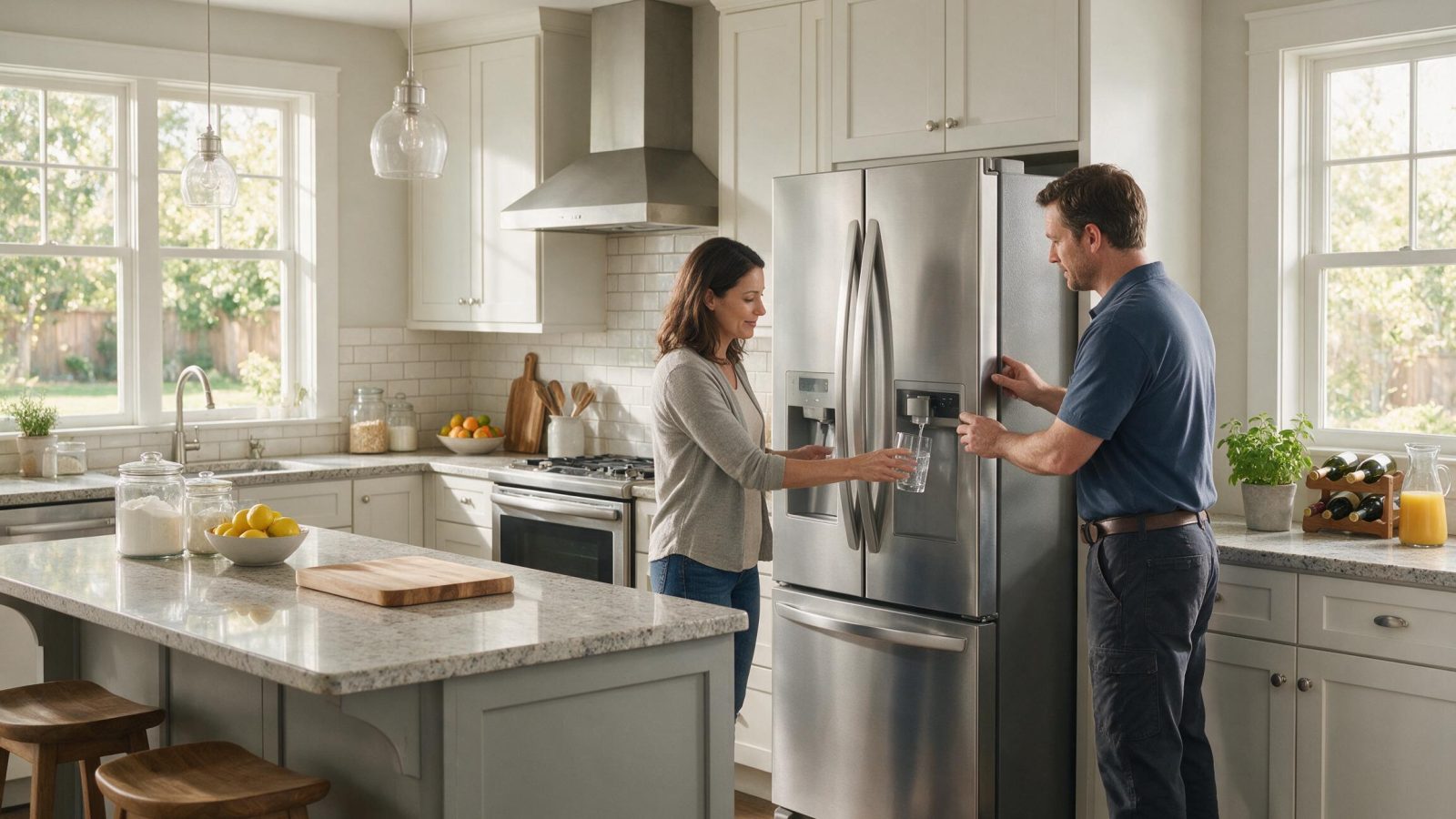
A dry or slow dispenser can be caused by the household supply, filter, tubing, frozen sections, door/interlock conditions, valve operation, paddle switch, or controls. Work through the path in order.
A dry or slow GE dispenser comes down to the water path: supply valve, filter, air in the line, a frozen section, or an interlock, in that order. Confirm the supply and filter first, since they are the ones you can verify from outside the cabinet.
A dry or slow dispenser can be caused by the household supply, filter, tubing, frozen sections, door/interlock conditions, valve operation, paddle switch, or controls. Work through the path in order.
Confirm household water supply to the refrigerator is available. A saddle valve that is only partly open can pass enough water for a trickle while starving the dispenser.
Check the filter is installed correctly and note whether flow changed after replacement. GE says new-construction sediment can clog a filter before the usual replacement interval.
Compare dispenser behavior with ice production if the model shares the same water path. If the ice maker gets water but the dispenser does not, that points toward the tank or tubing rather than the household supply.
| Symptom | What it can point to | What you can check |
|---|---|---|
| No water after installation or a filter change | Air in the line or a valve not fully open | Open the supply valve fully and dispense for 5 minutes or 2 gallons to purge air. |
| Slow flow, ice maker still works | Filter restriction | Install the bypass plug and dispense to test; GE says replace the filter every 6 months. |
| Ice works but water does not | A frozen tank or tubing | GE says to set it warmer and allow 24 to 48 hours. |
| Nothing happens when the paddle is pressed | Door wiring or interlock | If the doors were removed at installation, the wiring harness must be reconnected. |
| A few drops after dispensing | Normal dribble | Clean the recess grill under the dispenser periodically. |
GE refrigeration spans many generations and control platforms. Consumer-facing messages such as `PF`, `FF`, `CI`, `DE/dE`, and `CC` are not interchangeable with the multi-digit service diagnostics used by some French-door families. Keep every code tied to the exact model and context. Measured temperatures are more useful than a quick touch test. If one compartment is normal and another is not, say so. If the problem followed a power interruption, filter change, or prolonged door opening, record that too.
After installation or a filter change, GE says to confirm the supply valve is fully open and to purge air by dispensing for 5 minutes or 2 gallons. Hold the cradle down for 2 to 3 minutes to fill the reservoir. Top-freezer models with a dispenser have no reservoir.
GE says a frozen water tank behind the vegetable bins is often split or cracked and may leak. Causes include a low food load, poor loading, controls set too cold, or the meat pan lever on its coldest setting. If the ice maker gets water but the dispenser does not, the tank or tubing may be frozen; set it warmer and allow 24 to 48 hours.
Replace the water filter every 6 months, though sediment from new construction can clog it sooner. A bypass plug is the cleanest way to tell whether the filter is the restriction.
If supply and filter conditions are normal but dispensing remains inactive, internal valve, switch, tubing, freezing, wiring, or control diagnosis may be needed.
One small point is easy to miss: GE says that if the doors were removed during installation, the door wiring harness has to be reconnected, otherwise controls in the door will not respond.
Record the complete model number and any displayed code before resetting power. Code meaning must be matched to the correct GE appliance family and platform.
Leave built-in, stacked, or tightly fitted appliances installed unless the service team specifically requests access. Moving an appliance without a plan can disturb flooring, cabinetry, gas, water, drain, vent, or electrical connections and create a second problem.
The technician should reproduce the symptom or use your observations to select a narrow test path. That may involve comparing sensor readings, fan or pump commands, control output, airflow, water flow, ignition behavior, or stored diagnostics. The goal is to replace only what testing supports.
Write down:
– complete GE model number;
– exact symptom in one sentence;
– when it began;
– whether it is constant or intermittent;
– what related function still works normally;
– any displayed code/message before reset;
– any recent power, water, gas, venting, cleaning, filter, or installation event.
Do not clear codes before documenting them, do not order a part because another GE owner had a similar symptom, and do not apply one code meaning across unrelated appliance families. Some GE displays are status or operating messages rather than repair faults.
One controlled owner-level check is useful when it answers a question. Repeating resets or disassembling the appliance usually removes evidence rather than adding it.
One normal manual-approved reset can be useful after a temporary control interruption. Record the code or display state first. If the same symptom returns, repeated resets are not a repair.
Usually no. Similar symptoms can come from different components, installation conditions, or external utilities.
No. Keep homeowner checks external and model-appropriate.
Air in the line can slow flow. GE says to dispense for 5 minutes or 2 gallons to purge it, and to confirm the supply valve is fully open.
A few drops after dispensing is normal. Clean the recess grill under the dispenser periodically.
The tank or tubing may be frozen. GE says to set the refrigerator warmer and allow 24 to 48 hours.
One normal manual-approved reset can be useful after a temporary control interruption. Record the code or display state first. If the same symptom returns, repeated resets are not a repair.
Usually no. Similar symptoms can come from different components, installation conditions, or external utilities.
No. Keep homeowner checks external and model-appropriate.
On supported GE washers, an H2O SUPPLY message points the troubleshooting path toward water delivery or water-level sensing. Start outside the cabinet before assuming…
A microwave can light, run the fan, and turn the tray while failing to heat. That symptom can involve door sensing, controls, inverter/high-voltage components,…
A GE dryer that starts and then stops can be reacting to overheating, restricted airflow, door-switch interruption, motor protection, supply conditions, sensing, or control…
Request a repair on our homepage booking form, or call us and we’ll help right away.