Long drying time often looks like a heater problem even when the dryer is producing heat. A loaded lint filter, crushed transition duct, long vent, blocked exterior termination, or weak internal airflow can keep…
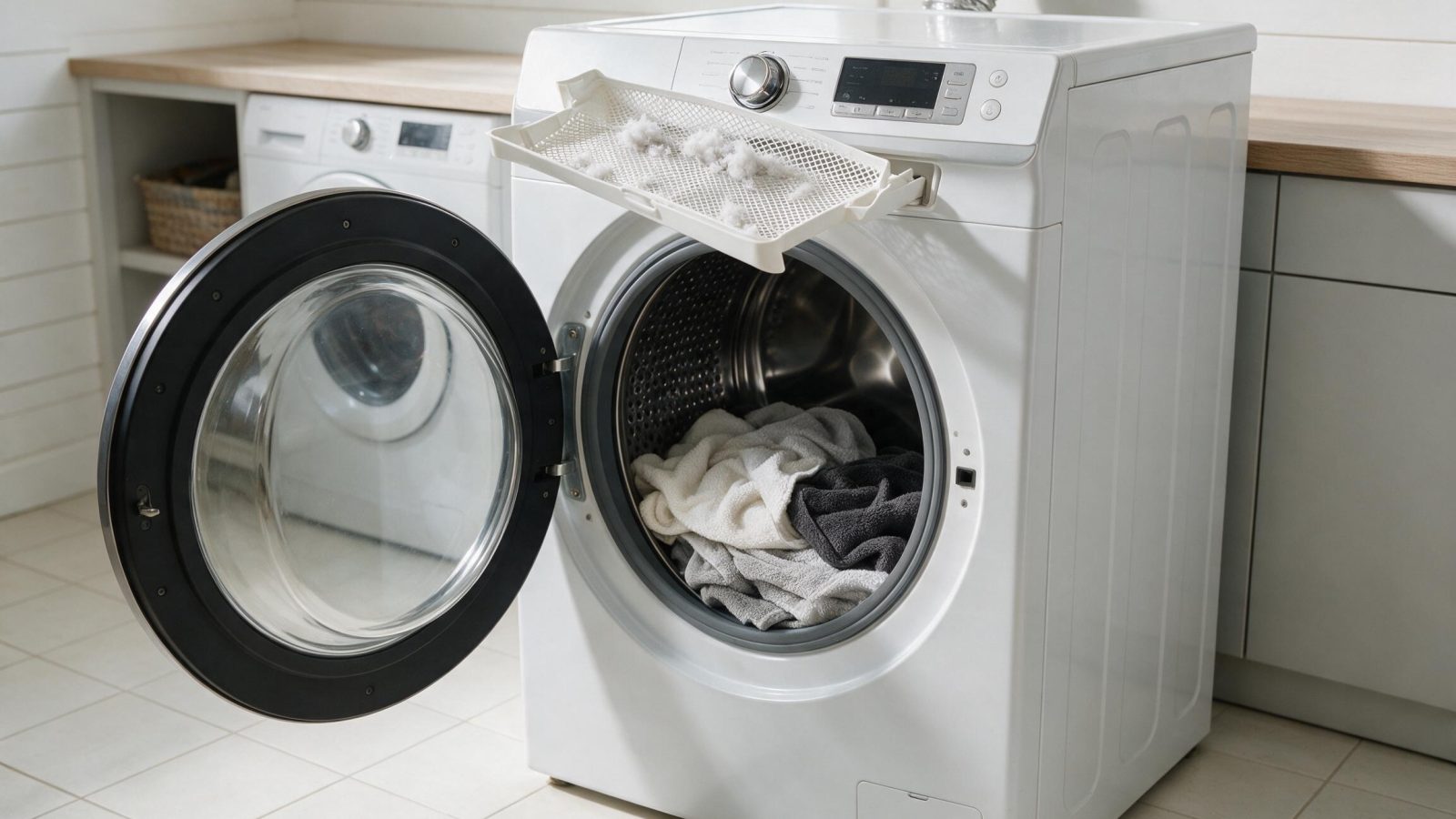
If a GE dryer takes too long to dry, check airflow before suspecting the heater. A full or film-coated lint filter, a crushed or kinked duct, a long vent run, and a stuck exterior flap are all owner-checkable, and they leave the dryer warm but unable to move moisture out.
Long drying time often looks like a heater problem even when the dryer is producing heat. A loaded lint filter, crushed transition duct, long vent, blocked exterior termination, or weak internal airflow can keep moisture trapped.
| Symptom | What it can point to | What you can safely check |
|---|---|---|
| Warm exhaust but damp clothes | Restricted vent, clogged filter, or weak airflow | Wash the filter in warm soapy water, check the duct for kinks, and see that the outside flap opens freely |
| Clothes slightly damp after a cycle on some models | Eco Dry (eDry) is the default on certain models and can leave clothes a little damp | Deselect it and choose Dry or More Dry |
| Long drying with a Check Vent alert | A blocked vent on models with an airflow sensor | Clear the vent path as soon as possible |
| Sensor-dry cycles end early or late | The dryer is not level, so clothes miss the moisture sensors at the lower front | Level the dryer and retest with a normal load |
| Wet clothes straight from the washer | A low washer spin speed leaves excess water | Choose a higher or extended spin and run the dryer again |
Do one check at a time. Changing several conditions at once hides the evidence that would have narrowed the problem. Keep items off the floor in front of the dryer, since air is drawn in along the front at floor level.
GE dryers may store numeric GFD-family codes or E-code families depending on platform. A code should not be published or linked without model context. For symptom work, prove airflow and heat separately before assuming a board or heater. If the dryer smells electrically hot, repeatedly trips power, or shuts down from heat, stop normal testing.
GE says drying time depends on heat type, load size, fabric, how wet the clothes start, and the condition of the venting. That list means a slow cycle is not automatically a heater problem.
GE recommends solid metal vent pipe 4 inches in diameter. Flexible metal works but increases drying time, and flexible white plastic can collapse, restrict airflow, and build up lint. Exceeding the vent length or elbow count allowed in the installation instructions can also leave condensation around the door.
If external venting is clear but drying remains slow, heat output, sensors, blower performance, drum seals, and controls may need diagnosis.
A repeated symptom deserves a model-aware test path rather than a part ordered from a generic symptom list.
An electric dryer connected at 120 volts instead of 240 can take up to three times longer to dry, so an unusually long cycle after a move or a new install is a reason to check the installation. A dryer in an unheated space can suffer condensation and longer cycles, because dryers are meant to operate in a heated area.
Rule out the washer too. If clothes arrive barely wrung out, the dryer has far more water to remove. GE says a washer that leaves clothes very wet at the end of a normal spin may need service itself.
Leave built-in, stacked, or tightly fitted appliances installed unless the service team specifically requests access. Moving an appliance without a plan can disturb flooring, cabinetry, gas, water, drain, vent, or electrical connections and create a second problem.
The technician should reproduce the symptom or use your observations to select a narrow test path. That may involve comparing sensor readings, fan or pump commands, control output, airflow, water flow, ignition behavior, or stored diagnostics. The goal is to replace only what testing supports.
Write down:
– complete GE model number;
– exact symptom in one sentence;
– when it began;
– whether it is constant or intermittent;
– what related function still works normally;
– any displayed code/message before reset;
– any recent power, water, gas, venting, cleaning, filter, or installation event.
Do not clear codes before documenting them, do not order a part because another GE owner had a similar symptom, and do not apply one code meaning across unrelated appliance families. Some GE displays are status or operating messages rather than repair faults.
One controlled owner-level check is useful when it answers a question. Repeating resets or disassembling the appliance usually removes evidence rather than adding it.
One normal manual-approved reset can be useful after a temporary control interruption. Record the code or display state first. If the same symptom returns, repeated resets are not a repair.
Usually no. Similar symptoms can come from different components, installation conditions, or external utilities.
No. Keep homeowner checks external and model-appropriate.
Heat does not dry clothes by itself, since moist air has to leave through the vent. A restricted filter or duct can leave heat trapped inside while the load stays damp.
GE says to clean the vent at least once a year and sooner after a Check Vent alert on models that have one. The lint filter itself needs cleaning after every use.
On some GE models Eco Dry (eDry) is the default and can leave clothes slightly damp. Deselect it and choose Dry or More Dry, and check your manual for the option names on your model.
One normal manual-approved reset can be useful after a temporary control interruption. Record the code or display state first. If the same symptom returns, repeated resets are not a repair.
Usually no. Similar symptoms can come from different components, installation conditions, or external utilities.
No. Keep homeowner checks external and model-appropriate.
A GE washer may refuse high-speed spin because water remains in the tub, the load is badly unbalanced, the lid or door is not…
A tray that browns harder on one side can be affected by cookware, rack position, door openings, convection airflow, temperature offset, or a heating-system…
When the freezer stays cold but the fresh-food section warms, the system may still be making cold normally. The useful question is whether air…
Request a repair on our homepage booking form, or call us and we’ll help right away.