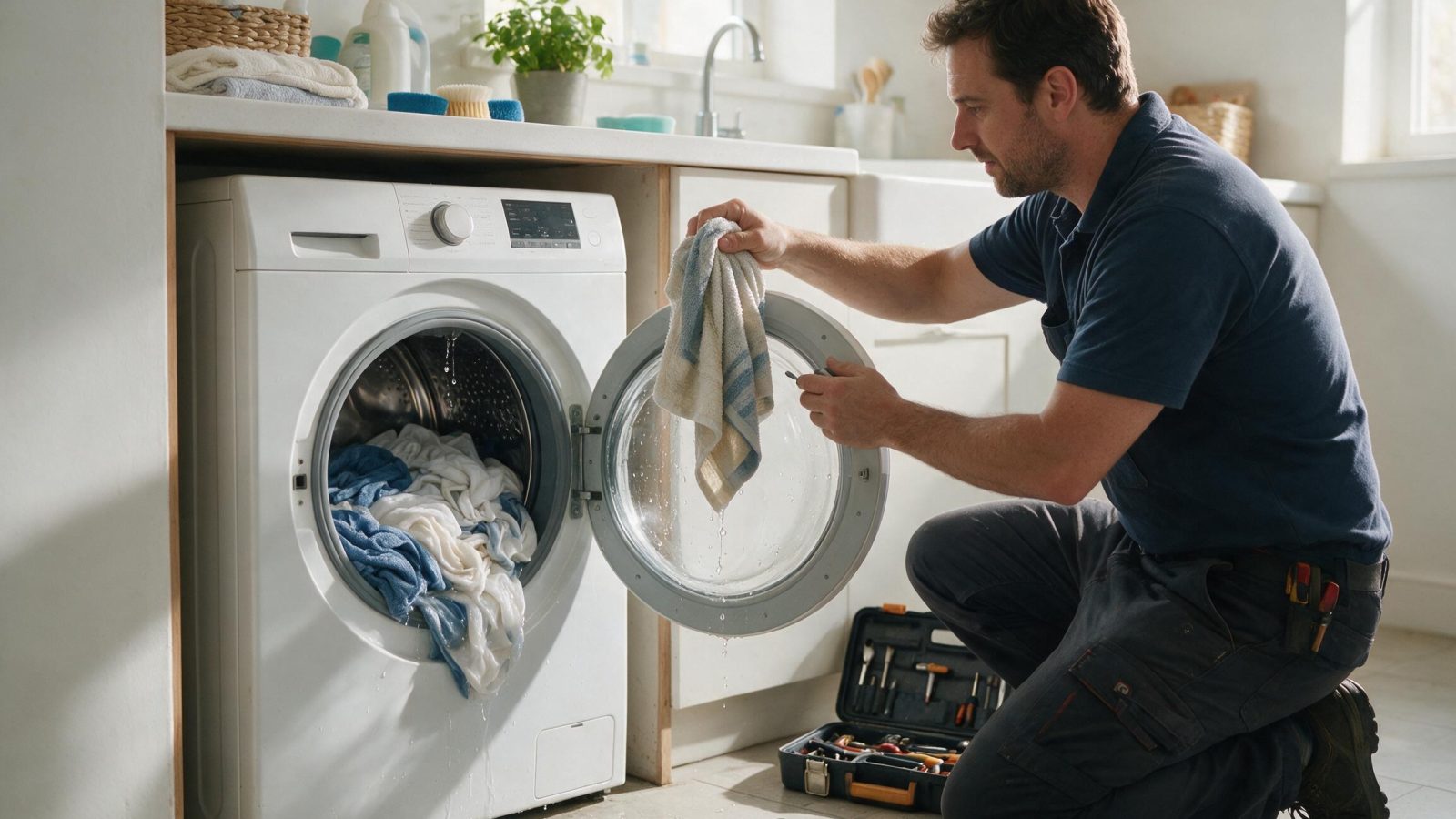
A GE washer may refuse high-speed spin because water remains in the tub, the load is badly unbalanced, the lid or door is not recognized, or the drive/control system cannot complete the transition.
If a GE washer will not spin, check the simple stops first: a lid up or a dispenser drawer left open, a load too small or too heavy to balance, water still in the tub, or a lost power connection. When a normal balanced load drains fully but still will not spin, the lock, drive, or control needs diagnosis.
A GE washer may refuse high-speed spin because water remains in the tub, the load is badly unbalanced, the lid or door is not recognized, or the drive/control system cannot complete the transition.
| Symptom | What it can point to | What you can safely check |
|---|---|---|
| Front-load washer fills and washes but stops before spin | Dispenser drawer not fully closed or a very small load | Close the drawer fully and add one or two similar items |
| Top-load washer will not spin with the lid up | The lid switch is not satisfied | Close the lid and start again |
| SPIN light blinking or bALAnCINg on a 2015 or newer top-load | An unbalanced load | Redistribute the laundry and press START |
| dE or E2 on a space-saving top-load | GE says the lid was opened | Close it and press Start/Pause |
| Shaking, then a stop mid-cycle | A load above the balance ring or unlevel feet | Reduce the load and level the washer |
Do one check at a time. Changing several conditions at once hides the evidence that would have narrowed the problem. Leaving laundry caught at the latch or around the lid edge is a simple cause of a missing spin, and it takes seconds to rule out. Loads that are mostly one heavy item, such as a single wet towel or comforter, can also confuse the balance sensing, so mix sizes where you can.
GE washers span front-load, top-load, HydroWave/CleanSpeak-era platforms, and newer connected designs. Numeric service codes can mean different things across families, while messages such as `H2O SUPPLY` can point toward owner-checkable water conditions. Record whether the machine fills, drains, locks, and attempts spin.
GE says washers can pause up to three minutes between stages and that pump-out can add up to three more, so do not advance the timer manually after agitation. Forcing the cycle can interrupt a sequence that was still working.
Power loss prevents spinning, and the outlet can be tested with a lamp or a hair dryer. If the lid is down and the power is on, an unbalanced or oversized load is the next thing to correct before assuming a part has failed.
If the machine drains normally but still will not spin, the technician may need to separate lock/lid sensing, motor/drive, wiring, inverter, and control causes.
A repeated symptom deserves a model-aware test path rather than a part ordered from a generic symptom list.
When the tub drains and the load is balanced, the remaining suspects are lock or lid sensing, the motor and drive, wiring, and the control. None of those is an owner check.
If the OPTIONS knob does not beep as you turn it, GE says the knob has failed and service is needed. The Hydrowave motor reset applies only to Hydrowave models, generally made 2011 to 2015, so it should not be tried on other washers.
Leave built-in, stacked, or tightly fitted appliances installed unless the service team specifically requests access. Moving an appliance without a plan can disturb flooring, cabinetry, gas, water, drain, vent, or electrical connections and create a second problem.
The technician should reproduce the symptom or use your observations to select a narrow test path. That may involve comparing sensor readings, fan or pump commands, control output, airflow, water flow, ignition behavior, or stored diagnostics. The goal is to replace only what testing supports.
Write down:
– complete GE model number;
– exact symptom in one sentence;
– when it began;
– whether it is constant or intermittent;
– what related function still works normally;
– any displayed code/message before reset;
– any recent power, water, gas, venting, cleaning, filter, or installation event.
Do not clear codes before documenting them, do not order a part because another GE owner had a similar symptom, and do not apply one code meaning across unrelated appliance families. Some GE displays are status or operating messages rather than repair faults.
One controlled owner-level check is useful when it answers a question. Repeating resets or disassembling the appliance usually removes evidence rather than adding it.
One normal manual-approved reset can be useful after a temporary control interruption. Record the code or display state first. If the same symptom returns, repeated resets are not a repair.
Usually no. Similar symptoms can come from different components, installation conditions, or external utilities.
No. Keep homeowner checks external and model-appropriate.
A dispenser drawer not fully closed or a load too small to balance can stop a front-load washer. A top-load model will not spin with the lid up.
Yes. Redistribute the laundry and restart. A load above the balance ring can cause shaking that stops the spin.
GE advises against manually advancing the timer after agitation. Wait through the pauses between stages and the pump-out time instead.
One normal manual-approved reset can be useful after a temporary control interruption. Record the code or display state first. If the same symptom returns, repeated resets are not a repair.
Usually no. Similar symptoms can come from different components, installation conditions, or external utilities.
No. Keep homeowner checks external and model-appropriate.
Long drying time often looks like a heater problem even when the dryer is producing heat. A loaded lint filter, crushed transition duct, long…
A tray that browns harder on one side can be affected by cookware, rack position, door openings, convection airflow, temperature offset, or a heating-system…
When the freezer stays cold but the fresh-food section warms, the system may still be making cold normally. The useful question is whether air…
Request a repair on our homepage booking form, or call us and we’ll help right away.