A tray that browns harder on one side can be affected by cookware, rack position, door openings, convection airflow, temperature offset, or a heating-system problem. Repeatability is the useful clue.
When a GE oven browns one side harder, rule out the tray, rack, and loading first, because they are free to change and can produce the same pattern. If the same side runs hot after a controlled retest and a biscuit test, the heating system is worth a diagnosis.
A tray that browns harder on one side can be affected by cookware, rack position, door openings, convection airflow, temperature offset, or a heating-system problem. Repeatability is the useful clue.
| Symptom | What it can point to | What you can safely check |
|---|---|---|
| One side of the tray always darker | Dark or warped pan, rack placed off-center, or a pan pushed too close to a wall | Use a shiny, flat sheet, center it, and keep 1 to 2 inches between the pan and the oven walls |
| Bottoms brown before tops | Rack height, a dark pan, or foil covering the whole shelf | Move the rack, avoid covering the entire shelf with foil, and retest |
| Results shift from bake to bake | Door openings, a rack inserted backwards that stops the door sealing, or normal temperature cycling | Keep the door shut during the test and seat the racks correctly |
| Heat still lopsided after the retest | Element, fan, temperature sensing, or door seal problem | Look at whether the bake element glows red during bake, then book service if it repeats |
Do one check at a time. Changing several conditions at once hides the evidence that would have narrowed the problem.
GE advises lowering the set temperature by 25 degrees when using dark pans, and the same adjustment applies when a convection or automatic conversion feature is doing the work. Skipping that change can brown the edges long before the center cooks.
Pans should sit 1 to 2 inches from the side walls and about 2 inches from the rear wall so air can move around them. Covering an entire shelf with foil blocks that movement, and frequent door openings lengthen cooking time and add to the unevenness.
GE range and wall-oven families use F-codes such as `F2`, `F3`, `F9`, and control/key-panel families, but messages like `LOC`, `OFF`, or Sabbath indicators can be operating states rather than faults. The exact model and display context matter. For gas cooking, include ignition and gas-odor details; for electric cooking, note whether bake, broil, and the display behave differently.
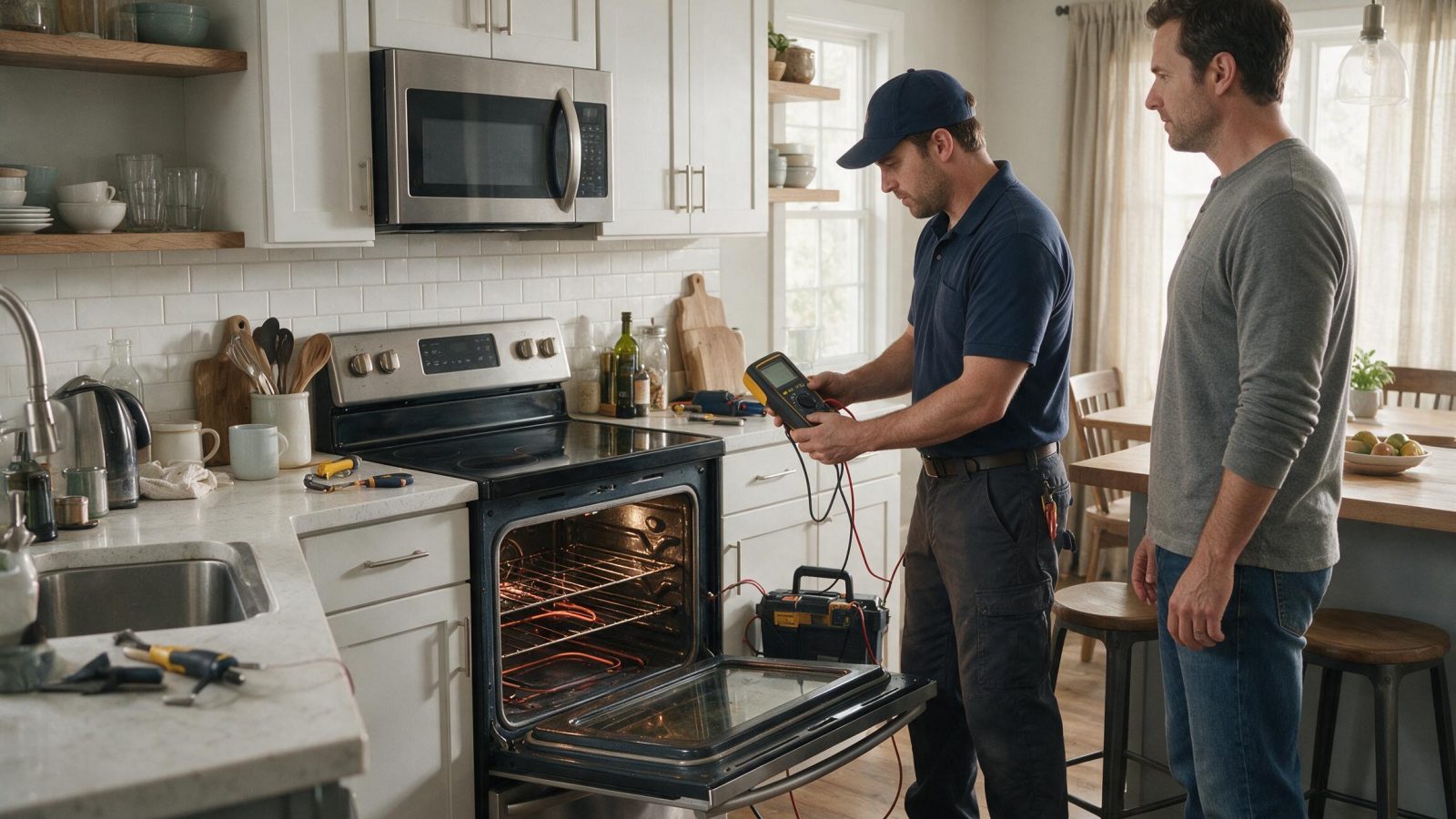
If the same hot/cold zone repeats under controlled conditions, the technician may need to test heating elements, fan operation, temperature sensing, door sealing, and controls.
GE prefers a biscuit test to an oven thermometer. Bake on a shiny aluminum sheet with sides no higher than half an inch, leave 1 to 1-1/2 inches of clearance to the walls, preheat until the tone or for 10 minutes, and keep the door closed until the minimum time on the package.
Biscuits that finish within the package’s time range indicate the oven is calibrated. Ovens also swing around the set temperature by roughly 30 degrees either way, so a small difference between readings is not by itself a fault, and readings vary with where they are taken and with room temperature.
If your model has up and down pads for an offset, the manual describes a limited adjustment. Make one change, then use the oven several times before changing it again, since the thermostat can drift over time.
A repeated symptom deserves a model-aware test path rather than a part ordered from a generic symptom list.
Leave built-in, stacked, or tightly fitted appliances installed unless the service team specifically requests access. Moving an appliance without a plan can disturb flooring, cabinetry, gas, water, drain, vent, or electrical connections and create a second problem.
The technician should reproduce the symptom or use your observations to select a narrow test path. That may involve comparing sensor readings, fan or pump commands, control output, airflow, water flow, ignition behavior, or stored diagnostics. The goal is to replace only what testing supports.
Write down:
– complete GE model number;
– exact symptom in one sentence;
– when it began;
– whether it is constant or intermittent;
– what related function still works normally;
– any displayed code/message before reset;
– any recent power, water, gas, venting, cleaning, filter, or installation event.
Do not clear codes before documenting them, do not order a part because another GE owner had a similar symptom, and do not apply one code meaning across unrelated appliance families. Some GE displays are status or operating messages rather than repair faults.
One controlled owner-level check is useful when it answers a question. Repeating resets or disassembling the appliance usually removes evidence rather than adding it.
One normal manual-approved reset can be useful after a temporary control interruption. Record the code or display state first. If the same symptom returns, repeated resets are not a repair.
Usually no. Similar symptoms can come from different components, installation conditions, or external utilities.
No. Keep homeowner checks external and model-appropriate.
Yes. GE describes ovens cycling about 30 degrees above and below the set temperature, and the reading depends on where it is measured and on door openings. A steady, repeatable lopsided pattern is a different matter.
GE favors the biscuit test over a thermometer because of how much readings vary with placement. Run it once with the door shut and compare the result with the package time range.
On models with up and down pads, the use-and-care manual describes an offset of up to 35 degrees in 1-degree steps. Change it once, then bake three to five times before touching it again.
One normal manual-approved reset can be useful after a temporary control interruption. Record the code or display state first. If the same symptom returns, repeated resets are not a repair.
Usually no. Similar symptoms can come from different components, installation conditions, or external utilities.
No. Keep homeowner checks external and model-appropriate.
A GE washer may refuse high-speed spin because water remains in the tub, the load is badly unbalanced, the lid or door is not…
Long drying time often looks like a heater problem even when the dryer is producing heat. A loaded lint filter, crushed transition duct, long…
When the freezer stays cold but the fresh-food section warms, the system may still be making cold normally. The useful question is whether air…
Request a repair on our homepage booking form, or call us and we’ll help right away.