A GE dishwasher can leave water because of a filter/sump restriction, disposer or sink connection, drain hose, pump, check path, or a control/sensing problem. Note exactly when the drain stops.
When a GE dishwasher leaves water behind, the cause sits somewhere between the tub and the kitchen drain: the filters and sump, the drain hose, the disposer or air gap, or a tub full of suds. Work through those in that order, one at a time. If water still pools after the checks GE documents, the next step is a model-aware diagnosis, not a guess at a part.
A GE dishwasher can leave water because of a filter/sump restriction, disposer or sink connection, drain hose, pump, check path, or a control/sensing problem. Note exactly when the drain stops.
Do one check at a time. Changing several conditions at once hides the evidence that would have narrowed the problem.
| What you see | What it can point to | What you can safely check |
|---|---|---|
| Water covers the tub bottom after the cycle | A restricted filter or rear sump | Remove and rinse the filters, then look in the rear sump for paper or large food pieces. |
| Foam or suds in the tub | Wrong type or too much detergent | Check the detergent type and the amount used. |
| Water stays and the sink also drains slowly | A clogged sink drain or disposer | Run the disposer to clear the drain before running the dishwasher. Never put a hand in the disposer. |
| Draining stopped after a new disposer went in | The drain plug inside the disposer was never removed | Follow the disposer’s installation instructions for removing the plug. |
| Water stays and the hose under the sink looks bent | A kinked or blocked drain hose | Look at the connection below the sink for kinks or blockages. |
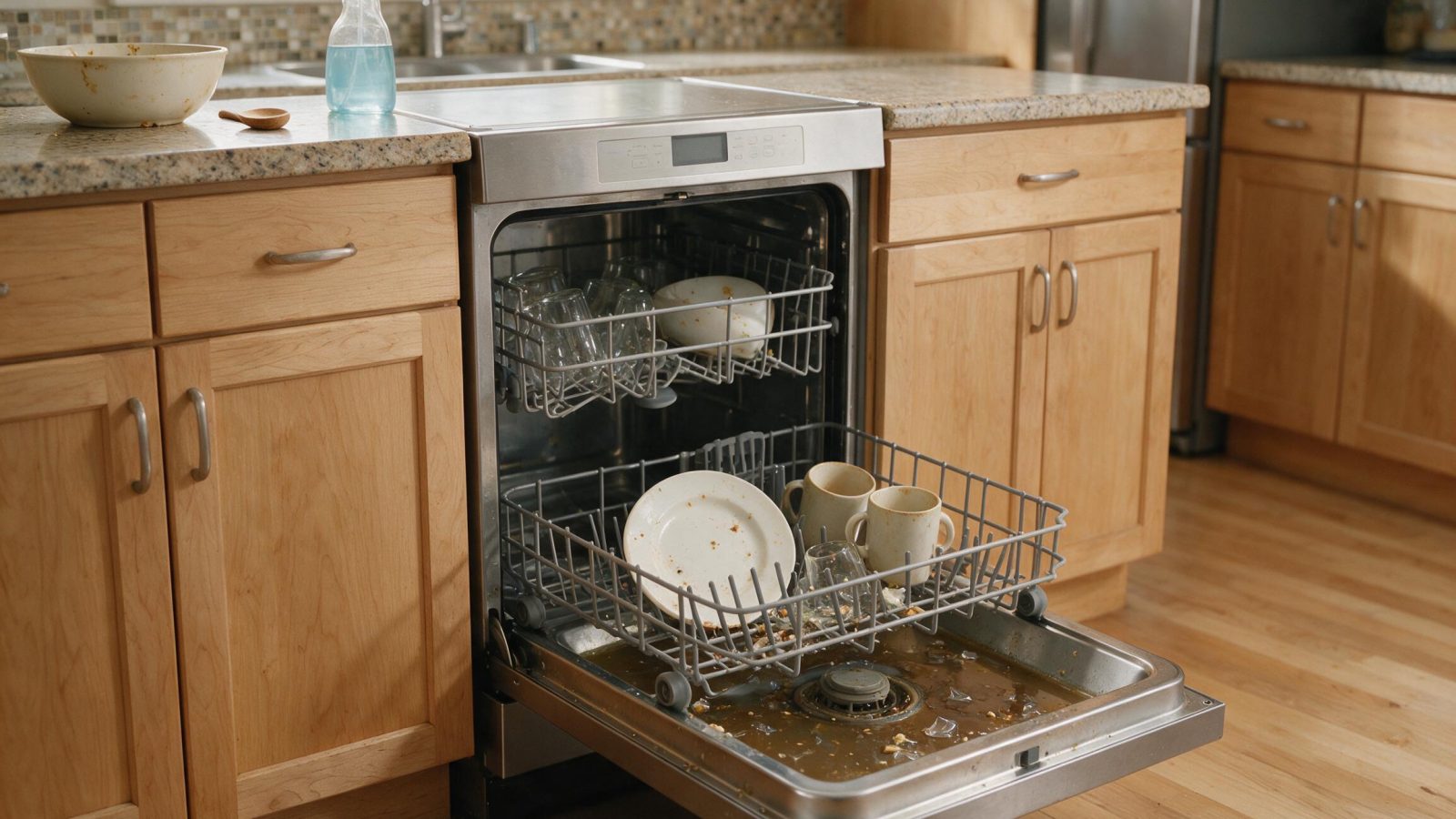
Not every puddle is a drain problem, and the answer depends on the filter design. On models without an Ultra Fine filter, one to two cups of clean water covering the tub bottom is normal. On models with an Ultra Fine filter, some water in the sump is normal, but it should not cover the tub bottom.
Many GE models have two filters, a Fine filter and an Ultra Fine filter, and both are worth checking when water stays in the tub. The Ultra Fine filter sits on top of the Fine filter and is reached after you take out the bottom rack. Twist it counterclockwise and lift it out. The Fine filter is a mesh plate at the back of the tub bottom, held by two retaining posts that also turn counterclockwise.
Rinse the Ultra Fine filter in warm soapy water, and avoid scouring pads and brushes because they can damage it. Hard-water calcium deposits on the Fine filter come off with a soft brush or sponge. When you put everything back, reinstall the Fine filter first, then the Ultra Fine filter, and twist it clockwise to lock.
GE describes this as routine maintenance, about every other month, or more often with heavy use, and sooner if wash results drop or dishes feel gritty. Older GE dishwashers and some newer models use self-cleaning filtration with no removable filter, so check the owner’s manual before looking for one.
GE dishwashers can use consumer messages such as `C1–C8`, `FTD`, `F56`, `H2O`, `PrS`, `LEAK DETECTED`, and model-family-specific F-codes. Some displays such as delay hours are status messages rather than repair faults. Describe the cycle stage—fill, wash, drain, heat/dry, or start/control—because that determines which technical family is relevant.
Water leaves through a drain hose that runs to the sink drain or disposer, so a restriction anywhere along that path looks the same from inside the tub. GE says to check the hose connection below the sink for kinks or blockages. New dishwashers come with a white corrugated drain hose, and GE says to use it because older hoses can kink or clog.
At the sink end, make sure the kitchen drain is clear. If there is a disposer, run it before the dishwasher. If an air gap is installed, take off its cap and clear out any debris. Without an air gap, the drain hose needs a high drain loop attached to the underside of the counter at the height given in the installation instructions.
If pooled water returns after accessible checks, model-aware diagnosis should separate pump, sensing, harness, control, and installation causes.
A repeated symptom deserves a model-aware test path rather than a part ordered from a generic symptom list.
Leave built-in, stacked, or tightly fitted appliances installed unless the service team specifically requests access. Moving an appliance without a plan can disturb flooring, cabinetry, gas, water, drain, vent, or electrical connections and create a second problem.
The technician should reproduce the symptom or use your observations to select a narrow test path. That may involve comparing sensor readings, fan or pump commands, control output, airflow, water flow, ignition behavior, or stored diagnostics. The goal is to replace only what testing supports.
Write down:
– complete GE model number;
– exact symptom in one sentence;
– when it began;
– whether it is constant or intermittent;
– what related function still works normally;
– any displayed code/message before reset;
– any recent power, water, gas, venting, cleaning, filter, or installation event.
Do not clear codes before documenting them, do not order a part because another GE owner had a similar symptom, and do not apply one code meaning across unrelated appliance families. Some GE displays are status or operating messages rather than repair faults.
One controlled owner-level check is useful when it answers a question. Repeating resets or disassembling the appliance usually removes evidence rather than adding it.
One normal manual-approved reset can be useful after a temporary control interruption. Record the code or display state first. If the same symptom returns, repeated resets are not a repair.
Usually no. Similar symptoms can come from different components, installation conditions, or external utilities.
No. Keep homeowner checks external and model-appropriate.
Yes, on many models. Without an Ultra Fine filter, one to two cups of clean water over the tub bottom is normal. With an Ultra Fine filter, water in the sump is normal, but it should not cover the tub bottom.
On models with Fine and Ultra Fine filters, GE suggests about every other month, or more often with heavy use. Clean them sooner if wash performance drops or dishes feel gritty. If your model has self-cleaning filtration, the manual will say whether anything needs removing.
One normal manual-approved reset can be useful after a temporary control interruption. Record the code or display state first. If the same symptom returns, repeated resets are not a repair.
Usually no. Similar symptoms can come from different components, installation conditions, or external utilities.
No. Keep homeowner checks external and model-appropriate.
A GE washer may refuse high-speed spin because water remains in the tub, the load is badly unbalanced, the lid or door is not…
Long drying time often looks like a heater problem even when the dryer is producing heat. A loaded lint filter, crushed transition duct, long…
A tray that browns harder on one side can be affected by cookware, rack position, door openings, convection airflow, temperature offset, or a heating-system…
Request a repair on our homepage booking form, or call us and we’ll help right away.