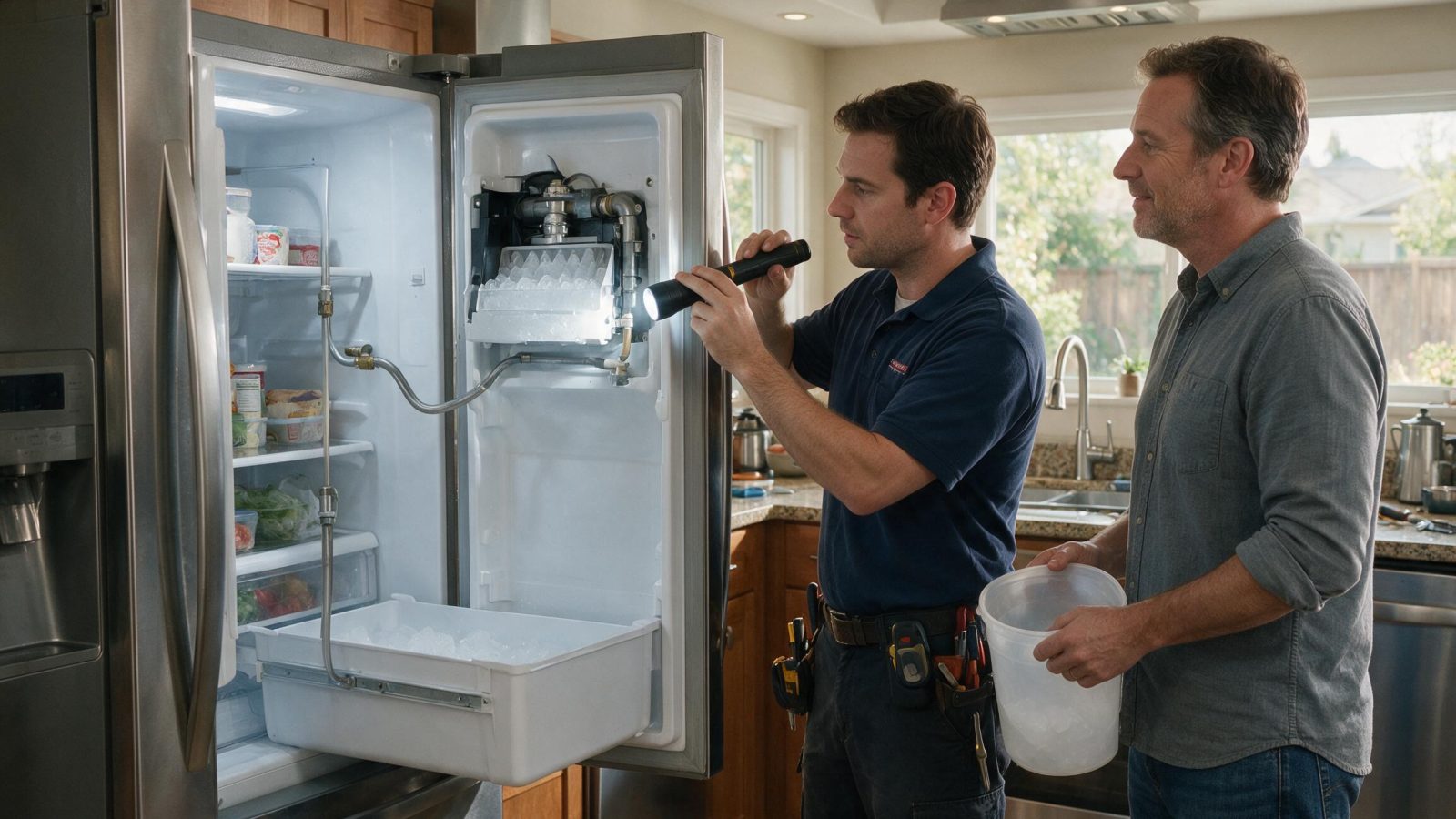
An empty ice bin can come from freezer temperature, water supply, filter condition, ice-maker controls, fill problems, or harvest hardware. A few basic observations can narrow the path before any part is ordered.
An empty ice bin usually means checking freezer temperature, water supply, and the filter before blaming the ice maker itself. GE guidance says the ice maker must reach 16F before a cycle starts, so a freezer that is too warm can stop production without any part failing.
An empty ice bin can come from freezer temperature, water supply, filter condition, ice-maker controls, fill problems, or harvest hardware. A few basic observations can narrow the path before any part is ordered.
Do one check at a time. Changing several conditions at once hides the evidence that would have narrowed the problem.
| Symptom | What it can point to | What you can check |
|---|---|---|
| No ice, freezer feels only cool | Freezer not cold enough for a cycle | Compare against the suggested 0F setting; the ice maker needs 16F before it starts. |
| Slow or small output after a filter change | Restricted water flow | Check the filter; GE says to replace it about every 6 months, sooner with sediment. |
| Bin empty, ice maker not filling | Supply valve, feeler arm, or frozen fill tube | Confirm it is plugged in and on, the arm is free of ice, and the supply valve is open. |
| Cubes jammed in the mold | Cycle cannot finish | Look for cubes blocking the mold, which may be hot; do not force the ejector. |
| Flashing green light | A fault state, not a normal cycle | See the section below for what GE says that light can mean. |
Ice production depends on freezer temperature, water supply, filter condition, fill hardware, harvest hardware, and control logic. Some GE refrigerator families also store service diagnostics for fresh-food or freezer ice makers, so a generic “ice maker code” should never be applied across every model. Do not force ejectors, bend fill tubes, or use sharp tools to remove ice.
GE suggests about 37F for the fresh-food section and 0F for the freezer. Ice production slows or stops when the freezer is warm, and a sparse freezer can also affect output, which is why GE says keeping it at least three-quarters full helps. After any setting change, give the freezer time to settle before judging.
On some GE ice makers a flashing green light indicates a fault. GE links it to a harvest lasting over 30 minutes, a stuck ejector rake from a jammed cube, a failed heater, or a failed motor. GE also documents a reset for those units: switch it off for 15 seconds, switch it on, and press the paddle exactly three times within 15 seconds, after which harvest should begin within 3 minutes. If the cause is a failed heater or motor, GE says the ice maker is replaced as a unit.
Check your own manual before trying that sequence, since it applies to specific models.
If temperature and water conditions are normal but production does not return after a reasonable harvest window, the fill, sensing, heater, motor, wiring, or control system may need testing. If the fill tube is frozen, GE says that calls for technician inspection rather than any attempt to clear it yourself.
A repeated symptom deserves a model-aware test path rather than a part ordered from a generic symptom list.
Leave built-in, stacked, or tightly fitted appliances installed unless the service team specifically requests access. Moving an appliance without a plan can disturb flooring, cabinetry, gas, water, drain, vent, or electrical connections and create a second problem.
The technician should reproduce the symptom or use your observations to select a narrow test path. That may involve comparing sensor readings, fan or pump commands, control output, airflow, water flow, ignition behavior, or stored diagnostics. The goal is to replace only what testing supports.
Write down:
– complete GE model number;
– exact symptom in one sentence;
– when it began;
– whether it is constant or intermittent;
– what related function still works normally;
– any displayed code/message before reset;
– any recent power, water, gas, venting, cleaning, filter, or installation event.
Do not clear codes before documenting them, do not order a part because another GE owner had a similar symptom, and do not apply one code meaning across unrelated appliance families. Some GE displays are status or operating messages rather than repair faults.
One controlled owner-level check is useful when it answers a question. Repeating resets or disassembling the appliance usually removes evidence rather than adding it.
One normal manual-approved reset can be useful after a temporary control interruption. Record the code or display state first. If the same symptom returns, repeated resets are not a repair.
Usually no. Similar symptoms can come from different components, installation conditions, or external utilities.
No. Keep homeowner checks external and model-appropriate.
GE says the ice maker must reach 16F before a cycle will start, and it suggests about 0F for the freezer. A warm freezer can slow or stop ice without any failed part.
GE guidance says about every 6 months, and sooner if sediment from new construction clogs it. A clogged filter can restrict the water the ice maker receives.
On some models it signals a fault such as a stuck rake, a harvest over 30 minutes, or a failed heater or motor. The manual for your model says whether a reset applies.
One normal manual-approved reset can be useful after a temporary control interruption. Record the code or display state first. If the same symptom returns, repeated resets are not a repair.
Usually no. Similar symptoms can come from different components, installation conditions, or external utilities.
No. Keep homeowner checks external and model-appropriate.
A GE washer may refuse high-speed spin because water remains in the tub, the load is badly unbalanced, the lid or door is not…
Long drying time often looks like a heater problem even when the dryer is producing heat. A loaded lint filter, crushed transition duct, long…
A tray that browns harder on one side can be affected by cookware, rack position, door openings, convection airflow, temperature offset, or a heating-system…
Request a repair on our homepage booking form, or call us and we’ll help right away.