
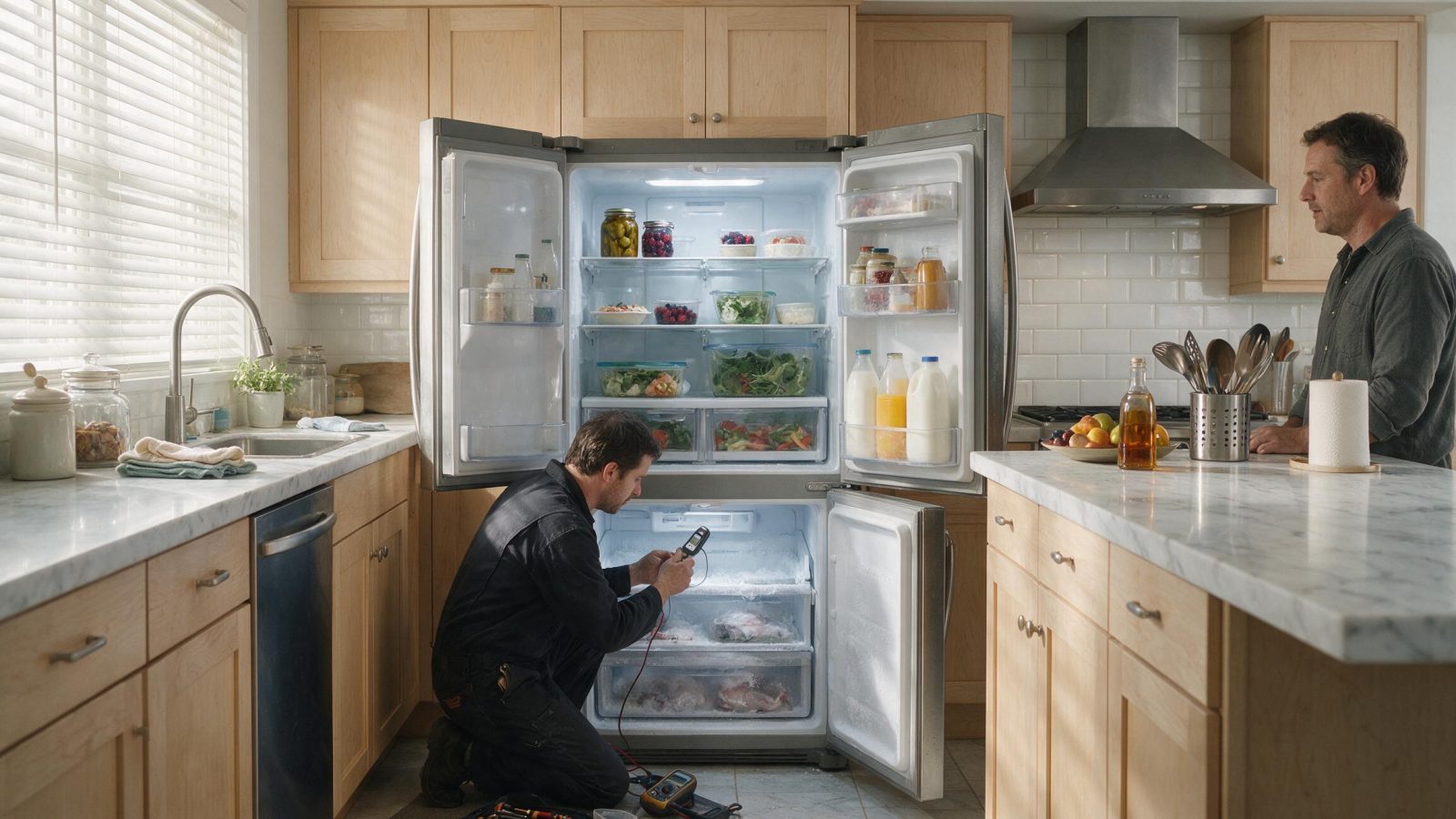
A GE refrigerator that suddenly feels warm does not always need a major repair. Start with the controls, airflow, door sealing, and installation conditions, then work toward fan, defrost, and sealed-system faults.
A refrigerator that is running but not keeping food cold can fail in several very different ways. Sometimes the fix is as simple as correcting a temperature setting or moving food away from an air vent. In other cases, the refrigerator may have a failed evaporator fan, a defrost problem, a bad sensor, a control issue, or a sealed-system fault that requires professional diagnosis.
The most useful clue is how the refrigerator is behaving, not just the temperature. Is the freezer cold while the fresh-food section is warm? Is the compressor running almost nonstop? Is there frost on the freezer wall? Are the fans silent? Did the problem start after moving the appliance, a power outage, a filter replacement, or a large grocery load?
This guide walks through the checks that make the most sense before parts are replaced.
For most household refrigerators, the fresh-food compartment should be around 37°F, while the freezer is typically set around 0°F. Exact controls and recommended settings can vary by model, so the owner’s manual should take priority over any generic number.
A refrigerator also needs time to stabilize. If the unit was just installed, unplugged, loaded with a large amount of room-temperature food, or had its doors open for an extended period, temperature recovery may take hours.
Open the refrigerator door and check for interior lights or an active display. If there is no sign of power, inspect the household breaker, outlet, and plug before assuming the refrigerator itself has failed.
If the lights work but the cabinet is warm, verify that the temperature controls were not accidentally turned off or placed into a special mode. Some models can appear powered while the compressor and fans are intentionally disabled by a control setting.
Also remember that a refrigerator periodically enters a defrost cycle. During that period, the compressor and fans may pause, which can briefly make the machine seem inactive.
Cold air is usually produced around the freezer evaporator and circulated through the cabinet. If containers, bags, or boxes block the air passages, the refrigerator can have a healthy refrigeration system but poor temperature distribution.
Look for vents at the back or upper portions of the fresh-food and freezer compartments. Leave space around them and avoid packing shelves so tightly that air cannot circulate.
This is especially important if the freezer seems normal but the refrigerator section is too warm.
A refrigerator cannot maintain temperature efficiently if warm, humid room air constantly enters around the doors.
Check the gasket for:
Clean the sealing surface with mild soap and water. If the gasket is visibly damaged or the door will not align correctly, the problem should be repaired rather than compensated for with a colder control setting.
Where the refrigerator is installed matters. GE notes that some refrigerators may not cool properly when the surrounding area is below about 60°F or above 110°F. Garages, enclosed patios, and poorly ventilated utility areas can therefore create cooling symptoms even when the appliance is not defective.
The refrigerator also needs clearance so heat can leave the cabinet. GE commonly recommends approximately one inch around the sides, top, and back, although exact clearance is model-specific.
If the refrigerator was recently pushed tightly against a wall or cabinetry, restore the required ventilation space.
A light frost coating on evaporator components can be normal, but a thick snow-like layer on the inside rear wall can indicate that the automatic defrost system is not clearing ice correctly.
When frost builds around the evaporator, airflow drops. The freezer may remain somewhat cold at first, while the refrigerator section gradually warms.
Potential causes include:
Do not chip ice with a knife or sharp object. Evaporator tubing is easy to puncture, and damaging it can turn a repairable defrost problem into an expensive sealed-system repair.
The evaporator fan moves cold air through the refrigerator. On many models, the fan runs when the compressor is operating, although door switches and variable-speed controls can affect when you hear it.
If the freezer is cold but there is little or no airflow into the refrigerator, a failed or ice-blocked evaporator fan is a strong possibility.
Warning signs include:
Fan access typically requires removing interior freezer panels, so this is a reasonable point to move from homeowner checks to professional diagnosis.
Depending on the model, condenser coils may be accessible underneath or behind the refrigerator, while other designs use configurations that require little routine coil cleaning.
If your model has accessible coils or an exposed condenser area, excessive dust, pet hair, or blocked airflow can reduce the refrigerator’s ability to release heat.
Disconnect power before cleaning around mechanical or electrical components. Use a soft brush or vacuum attachment rather than bending tubing or pulling wiring.
Compressor behavior provides valuable diagnostic information.
A compressor that runs for very long periods can point to heavy heat load, poor airflow, door leakage, dirty condenser conditions, weak refrigeration performance, or a control/sensor issue.
A compressor that repeatedly clicks on and off may have a start-device, power-supply, compressor, or control problem.
If the refrigerator has power and the controls are calling for cooling but neither the compressor nor the expected fans operate, diagnosis should include the control system and electrical components.
The sealed system includes the compressor, evaporator, condenser, refrigerant tubing, and refrigerant charge. Homeowners should not open or recharge this system.
A sealed-system issue becomes more plausible when:
These faults require specialized tools and refrigerant-handling procedures.
Before scheduling repair, verify:
1. The refrigerator has power. 2. Cooling is enabled and temperatures are correctly set. 3. The doors fully close and gaskets seal. 4. Interior vents are not blocked. 5. The refrigerator has adequate exterior clearance. 6. The installation area is not extremely hot or cold. 7. There is no heavy frost blocking the evaporator area. 8. Fans sound normal and airflow is present. 9. The compressor is not repeatedly clicking or failing to start.
Schedule service if basic airflow, settings, and door checks do not restore cooling, or if you see heavy frost, hear abnormal compressor sounds, lose evaporator airflow, or suspect an electrical or sealed-system failure.
A technician can test temperature sensors, fan motors, defrost components, control outputs, compressor current, and sealed-system pressures instead of replacing parts based only on symptoms.
If your GE refrigerator is warm, cycling abnormally, frosting over, or not recovering after basic checks, request a diagnosis. Include the model number and describe whether the freezer is still cold; that detail can significantly narrow the likely fault.
The most common categories are blocked airflow, door leakage, condenser airflow problems, evaporator fan failure, defrost-system failure, sensor/control faults, or a sealed-system problem.
This often points to an airflow problem between the freezer and fresh-food section. Check blocked vents and excessive frost first; an evaporator fan or damper problem may also be involved.
A brief power reset can clear some electronic-control problems, but it will not repair a failed fan, defrost component, compressor, or refrigerant problem. Preserve food safety and follow the model’s owner documentation.
Give the refrigerator time to stabilize rather than repeatedly changing the control. A full cabinet temperature change can take many hours, especially after loading food or opening the doors repeatedly.
Restricted heat rejection can reduce cooling performance and increase run time. Whether and how condenser cleaning applies depends on the refrigerator design.
Need help now? Visit our services page or contact us.
Official manuals and support notes are available on GE owner support.
Remember: Why Is My Ge is easier to resolve when you capture the model number and when Why Is My Ge first appeared.
Write down the full model number before ordering parts. Board and sensor revisions can change which part number is correct.
A single power reset can clear a temporary fault, but repeated returns of the same code usually mean a physical cause remains.
Keep vents and filters clear between visits. Restricted airflow often mimics electrical or sensor failures.
If water, burning smells, or sparking are present, stop using the appliance and arrange a professional inspection.
Poor wash results are often a system problem rather than one failed part. The dishwasher needs hot water, correct detergent chemistry, adequate fill, unrestricted…
Wet dishes do not always indicate a failed heater. Rinse aid, loading, cycle selection, incoming temperature, dish material, and the dishwasher’s specific drying technology…
Beeps and flashing LEDs are not one universal GE error. They can signal a door event, reset, button tone, interrupted cycle, power disturbance, or…
Request a repair on our homepage booking form, or call us and we’ll help right away.