
Wet dishes do not always indicate a failed heater. Rinse aid, loading, cycle selection, incoming temperature, dish material, and the dishwasher’s specific drying technology all affect the result.
Drying complaints are easy to misdiagnose because not every GE dishwasher dries in the same way. Some rely heavily on heated drying, some combine heat with venting, and newer designs may use different drying features. Plastics also behave differently from glass and ceramic because they retain less heat.
Before replacing a heating element, compare the results with the options and drying system used by your exact model.
Some cycles reduce or eliminate active drying to save energy or shorten cycle time.
Check whether Heated Dry, Dry Boost, or another drying option is available and enabled. Names vary by product generation.
If you choose a quick or energy-saving cycle, wetter dishes may be expected.
GE specifically recommends rinse aid for better drying performance.
Rinse aid reduces surface tension so water sheets off dishes rather than remaining as droplets. This is especially helpful for glassware and stainless surfaces.
Check the dispenser level and adjust dosage only as described in the owner’s manual.
Hot dishes evaporate water more readily at the end of the cycle.
GE support commonly recommends incoming water around 120°F for proper dishwasher performance on many models.
Run the kitchen faucet until hot before starting the dishwasher if the hot-water line cools between uses.
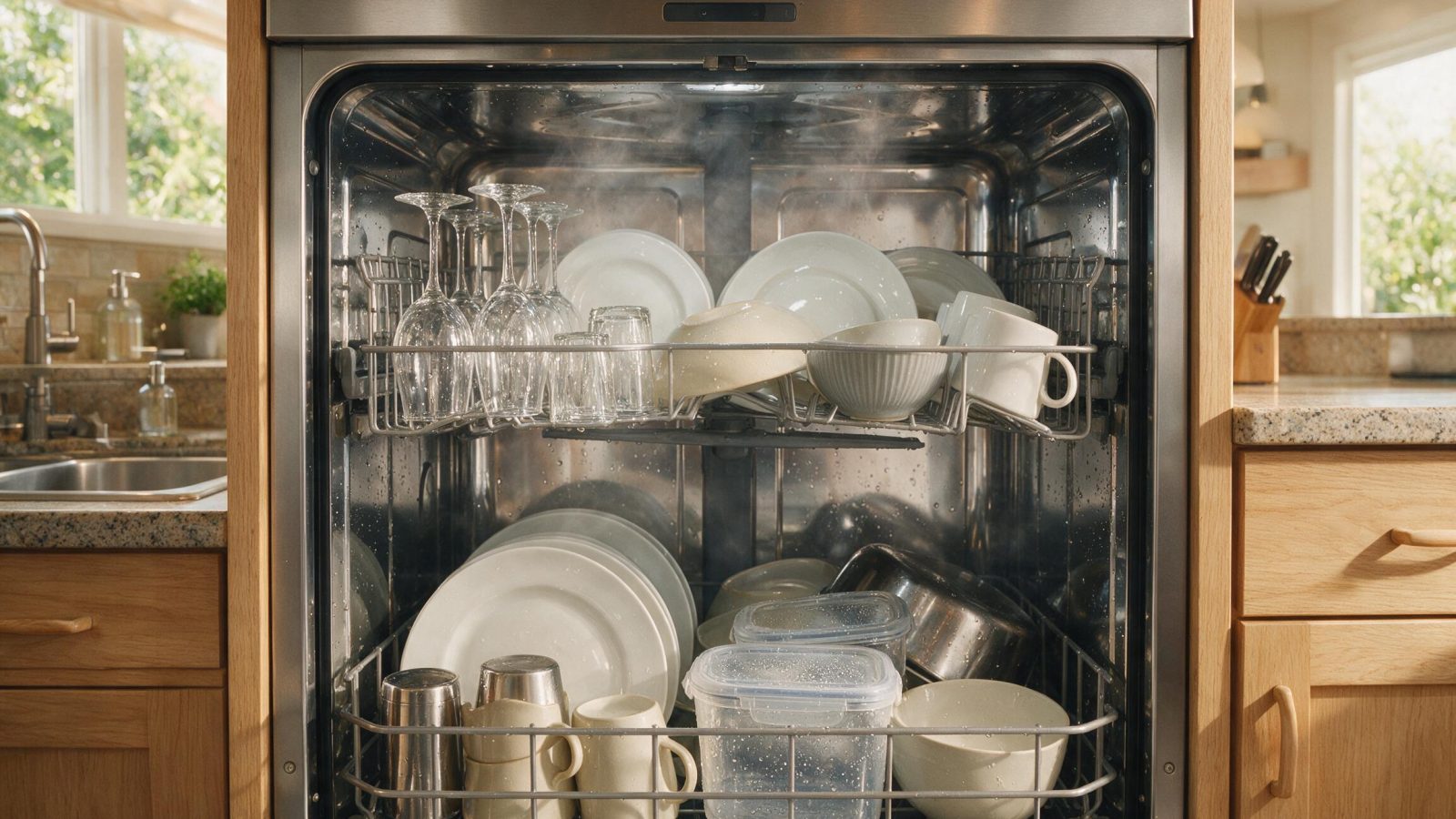
Bowls, mugs, and containers with concave bottoms can collect a small pool of water even when the rest of the load is dry.
Load items at an angle where possible and avoid allowing dishes to touch closely.
GE also recommends unloading the lower rack first so water trapped on upper-rack items does not spill onto dry dishes below.
Plastic does not store heat as effectively as ceramic, glass, or metal. As a result, plastic containers often retain water droplets even when the dishwasher’s drying system is functioning normally.
Judge drying performance using the full load, not one lightweight plastic lid.
Dishwashers that vent moist air need that path to remain open.
A blocked, damaged, or malfunctioning vent can trap humidity inside the tub. On electronically controlled designs, a vent fan or wax motor may also be involved depending on model.
If the machine remains unusually steamy long after the cycle ends, vent operation deserves inspection.
On models that use an exposed or concealed heater for drying, a failed heating circuit can leave the entire load noticeably wetter.
Other clues may include:
Testing can involve resistance, wiring, high-limit protection, relays, and control output.
Opening the door immediately at the wrong point can interrupt the designed drying process. Conversely, some dishwasher designs benefit from the door being opened after the cycle is complete to release remaining humidity.
Follow the model’s recommended use rather than a generic rule.
A dishwasher with standing water has a drainage problem, and that extra moisture can make everything feel wet.
If dirty water remains in the bottom, solve the drain issue before diagnosing the drying heater.
Temperature sensors and controls determine when heating is safe and appropriate. If the dishwasher never powers the heater despite correct settings, a sensor, relay, wiring, or control fault may be responsible.
Do not bypass temperature protection to test the heater.
Request service if the dishwasher has proper hot water, rinse aid, loading, and cycle settings but the entire load remains wet and heating/vent operation appears absent.
Provide the model number and tell the technician whether the dishes are warm at cycle end, whether only plastics stay wet, and which dry option was selected.
Check more than whether droplets remain. At the end of a normal heated cycle, are ceramic plates and the stainless tub warm? Did the final rinse use hot water? Is the rinse-aid reservoir filled? If hard, heat-retaining items are warm and mostly dry while only plastics remain wet, the drying system may be functioning normally.
A more concerning pattern is an entire load that is cool and wet after a cycle specifically configured for heated drying. On heater-equipped models, a technician can test the heating element, high-limit protection, temperature sensor, wiring, and control relay. On vent- or fan-assisted models, the vent mechanism also needs to operate correctly.
Drying diagnosis is therefore model-specific. The same symptom on two GE dishwashers can involve different hardware depending on the drying technology installed.
Allow space between items, angle cups and bowls so they do not hold puddles, keep rinse aid filled when recommended, and start the dishwasher with appropriately hot incoming water. Do not open the door early enough to interrupt the cycle. At unloading, remove the lower rack first so trapped water from the upper rack does not drip onto dishes below.
A new dishwasher may use a different drying strategy from the machine it replaced. Owners sometimes expect the tub and every plastic item to feel completely dry because an older model used a more aggressive exposed heater. Review the selected cycle and model features before treating different drying behavior as a defect.
Also verify the installation is level and that the drain system is not leaving excess water behind. A machine that retains dirty water at the end of the cycle has a drainage problem that can overwhelm normal drying performance.
Opening the door before the final rinse or dry phase finishes can leave dishes noticeably wetter. If the household routinely opens the dishwasher to add an item late in the cycle, verify that the cycle is resumed correctly and allowed to complete.
Also check whether a power interruption occurred. A dishwasher that never reached its final heated rinse or drying phase can leave a wet load even when the drying hardware itself is healthy.
Common reasons include no drying option, empty rinse aid, cool incoming water, trapped water from loading, plastic items, vent problems, drainage issues, or a failed heating circuit.
Yes. GE specifically recommends rinse aid because it helps water sheet off dish surfaces and accelerates drying.
Plastic retains less heat than glass or ceramic, so water evaporates from it less effectively.
Yes on models that depend on a heater, but settings, rinse aid, temperature, and drainage should be checked first.
Water trapped on upper-rack items can spill onto dishes below when the upper rack is moved.
This article covers Ge Dishwasher Not Drying with practical checks you can run before booking a technician.
Need help now? Visit our services page or contact us.
Official manuals and support notes are available on GE owner support.
Remember: Ge Dishwasher Not Drying is easier to resolve when you capture the model number and when Ge Dishwasher Not Drying first appeared.
Write down the full model number before ordering parts. Board and sensor revisions can change which part number is correct.
A single power reset can clear a temporary fault, but repeated returns of the same code usually mean a physical cause remains.
Keep vents and filters clear between visits. Restricted airflow often mimics electrical or sensor failures.
If water, burning smells, or sparking are present, stop using the appliance and arrange a professional inspection.
A GE washer that will not drain may have a kinked hose, installation problem, clogged front-load pump filter, blocked pump, failed drain motor, or…
A GE washer may refuse to spin because the load is unbalanced, water has not drained, the lid or door is not locking, or…
Some vibration is normal during spin, but a GE washer that walks across the floor, bangs the cabinet, or repeatedly stops to rebalance needs…
Request a repair on our homepage booking form, or call us and we’ll help right away.