
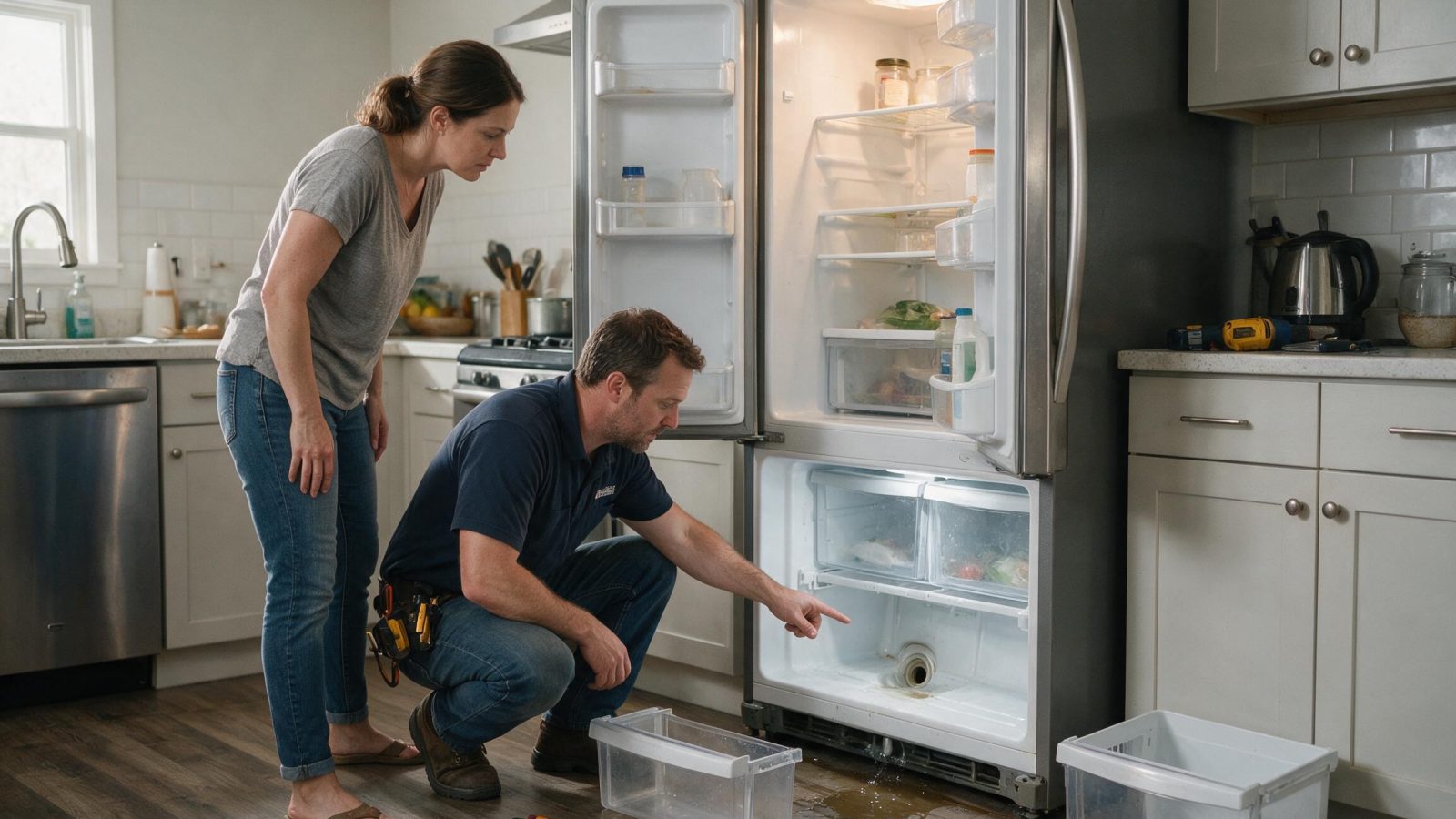
Water beneath vegetable or deli drawers is a location-specific clue. Depending on the GE refrigerator design, the source may be a clogged defrost drain, leaking water reservoir, tubing connection, or excess condensation.
Discovering a shallow puddle under the crisper drawers is frustrating because there may be no visible drip above it. Water often travels along the liner before collecting at the lowest point, so the place where you find it is not always the exact place where the leak began.
GE support specifically identifies internal water storage components and defrost drainage as possible causes on certain refrigerator styles.
Remove the drawers and inspect the bottom of the fresh-food compartment.
Dry the area completely before testing so new moisture is easy to trace.
Some GE side-by-side refrigerators use a water storage tank or reservoir in the fresh-food section to chill dispenser water.
GE notes that water or ice under vegetable bins on some side-by-side models can indicate a leak in this storage tank.
A simple clue is whether moisture appears while the water dispenser is operating. If you can safely see the reservoir area with the drawers removed, watch for fresh droplets while someone dispenses water.
If the tank or its connections leak, shut off the refrigerator water supply until repaired.
The refrigerator periodically melts frost from the evaporator and sends the water to a drain pan.
A blocked drain can redirect water into the cabinet. Depending on refrigerator style, that moisture may appear under freezer baskets, beneath fresh-food drawers, or eventually on the floor.
If you also see ice at the bottom of the freezer or periodic floor puddles, drainage deserves extra attention.
The dispenser and ice-maker circuits contain plastic tubing and fittings. A line can leak only when pressurized during dispensing or filling.
Look for a pattern:
This strongly supports a plumbing-side problem rather than simple condensation.
A filter housing or improperly seated cartridge can allow water to travel down the inside wall and collect beneath the drawers.
If the problem began after replacing the filter, inspect that area first. Verify correct filter type and installation.
Do not assume that because the filter itself looks dry, it cannot be involved; a small leak can follow hidden surfaces.
Warm, humid room air can condense inside the refrigerator if the door gasket leaks or the door is frequently left open.
Check for:
Condensation usually produces a broader moisture pattern rather than a strong stream from one water-system component.
Before disassembling anything, rule out a leaking bottle, produce bag, meat package, or defrosting item.
Remove the drawer contents, dry the compartment, and monitor it with no liquid containers nearby. This simple test can save an unnecessary repair call.
If the leak is not severe and no electrical components are wet:
1. Dry the area completely. 2. Do not use the dispenser or ice maker for several hours. 3. Check for new water. 4. Then dispense several glasses while observing accessible tubing/tank areas. 5. Check again after the ice maker cycles.
If water appears only after a specific water-system event, you have narrowed the source considerably.
Turn off the refrigerator’s water supply if:
The refrigerator can generally continue cooling without a connected water supply, although dispenser and ice-maker functions will be unavailable.
Request repair if the reservoir, tubing, filter housing, or drain system cannot be accessed safely, or if water repeatedly returns after obvious spill and gasket causes are eliminated.
Tell the technician whether the water appears only after dispenser use, whether ice is also present under the freezer basket, and whether shutting off the water supply stops the leak.
A defrost-drain problem and a dispenser-reservoir leak can leave water in the same general area, but their timing is different. A pressurized-water leak often appears while the dispenser is used or shortly after the ice maker fills. A drainage problem may show up periodically even when no one uses the dispenser because automatic defrost happens on its own schedule.
If safe, dry the compartment completely and document when moisture returns. A towel placed under an accessible reservoir area can reveal a fresh drip, while recurring ice under the freezer basket strengthens the case for a drain problem.
This kind of observation is more useful than adding sealant around random interior seams. Refrigerator liners and drain channels are engineered pathways; sealing the wrong area can redirect water and make the actual source harder to find.
Do not drill, puncture, or pry into the refrigerator liner to “find the drain.” Water passages and refrigerant tubing can be hidden behind plastic surfaces. Use only owner-accessible panels and model-specific instructions.
If the leak is slow, line the drawer floor with dry paper towels and check which edge becomes wet first. This low-risk method can reveal whether water is traveling from the rear wall, filter area, reservoir side, or door side without damaging the cabinet.
If you can safely shut off the refrigerator water line, leave the unit cooling normally and monitor the drawer area. If the puddle no longer returns, the pressurized dispenser/ice-maker plumbing becomes much more likely. If water continues to appear with the supply off, focus on defrost drainage, condensation, or an unrelated spill source.
This isolation test is useful because it separates two systems that can produce nearly identical puddles.
Depending on model, possible causes include an internal water reservoir leak, blocked defrost drain, tubing/filter leak, condensation, or a simple spilled container.
Yes. GE documents leaking water storage tanks as one potential cause on certain side-by-side models.
The leaking water may be reaching a cold surface, or a drainage/airflow problem may be causing local freezing.
Shutting off the supply and observing whether the leak stops is a useful clue. Timing the leak against dispenser and ice-maker operation also helps.
If cooling is normal and no electrical components are wet, you may be able to keep the appliance cooling with the water supply shut off until repair. Address active leaks promptly.
This article covers Ge Refrigerator Has Water with practical checks you can run before booking a technician.
Need help now? Visit our services page or contact us.
Official manuals and support notes are available on GE owner support.
Remember: Ge Refrigerator Has Water is easier to resolve when you capture the model number and when Ge Refrigerator Has Water first appeared.
Write down the full model number before ordering parts. Board and sensor revisions can change which part number is correct.
A single power reset can clear a temporary fault, but repeated returns of the same code usually mean a physical cause remains.
Keep vents and filters clear between visits. Restricted airflow often mimics electrical or sensor failures.
If water, burning smells, or sparking are present, stop using the appliance and arrange a professional inspection.
Beeps and flashing LEDs are not one universal GE error. They can signal a door event, reset, button tone, interrupted cycle, power disturbance, or…
A GE washer that will not drain may have a kinked hose, installation problem, clogged front-load pump filter, blocked pump, failed drain motor, or…
A GE washer may refuse to spin because the load is unbalanced, water has not drained, the lid or door is not locking, or…
Request a repair on our homepage booking form, or call us and we’ll help right away.