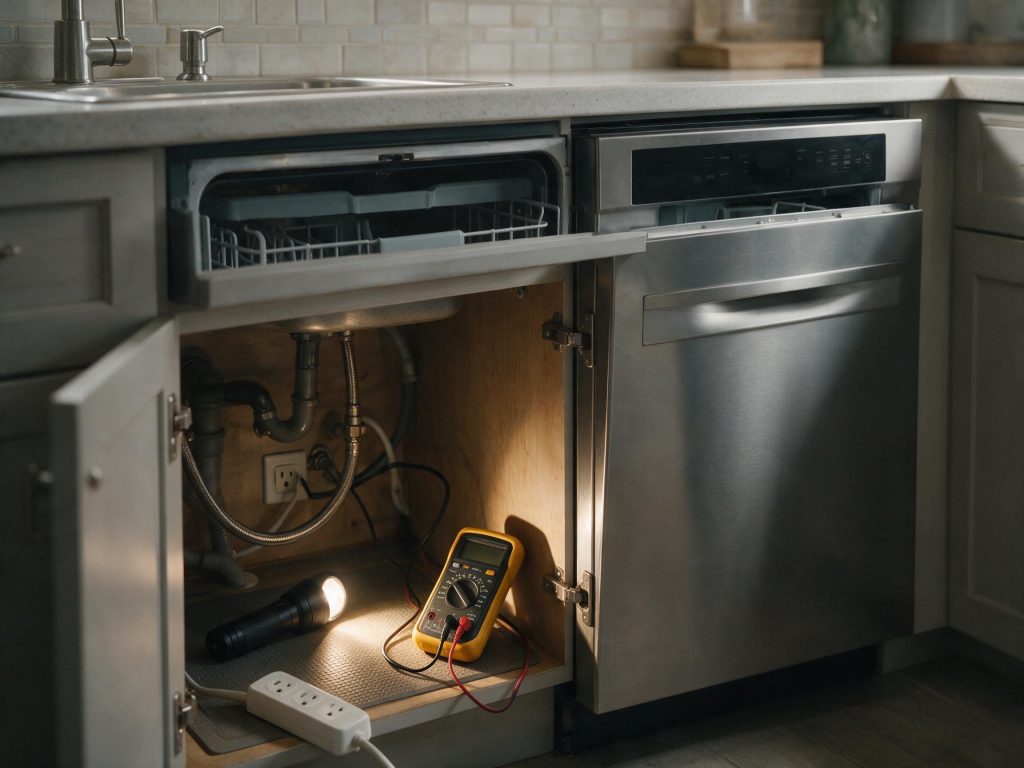


The location of a dishwasher leak matters. Water from the door points toward different causes than water under the cabinet or at the sink air gap. Identify the leak zone before removing parts.
A leaking dishwasher can damage flooring and cabinetry quickly, so this is one symptom that should not be ignored. Before assuming the tub or pump has failed, figure out exactly where the first water appears.
GE separates dishwasher leak troubleshooting by location because door leaks, under-unit leaks, and plumbing leaks often have different causes.
If water is actively escaping:
1. Stop the cycle. 2. Turn off dishwasher power if water is near electrical components. 3. Shut off the dishwasher water supply if the leak continues. 4. Dry the floor so you can identify fresh water. 5. Photograph the leak location before cleanup if possible.
Do not keep restarting the dishwasher just to “see if it happens again” when a large leak is already confirmed.
Door leaks often come from sealing, alignment, excessive suds, or water being redirected toward the front of the tub.
Check the door gasket for:
GE notes that gasket layout differs by model. On some designs, a gap at the bottom of the gasket is intentional, so compare the seal with model-specific information before assuming it is missing a section.
A dishwasher can latch without sealing correctly if the door or control panel contacts adjacent cabinetry.
This is particularly relevant after a new installation or countertop/cabinet work.
Check that:
If the door must be pushed sideways to latch, alignment should be corrected.
GE specifically identifies a loose vent cap on certain models as a source of door leakage. If your model has an interior vent cap near the upper corner of the door, confirm it is properly seated and hand-tightened according to the owner information.
Do not overtighten plastic parts.
Using hand dish soap or too much automatic dishwasher detergent can create foam that pushes water past seals and out of the tub.
GE also warns that spilled rinse aid can contribute to sudsing.
If you see a tub full of foam:
A suds leak does not necessarily mean the gasket is bad.
A split spray arm or blocked jet can direct a concentrated stream of water toward the door.
Inspect accessible spray arms for:
Clear user-serviceable spray-arm holes carefully. Replace a physically split arm rather than trying to seal it.
An under-unit leak is more concerning because pumps, hoses, valves, and tub connections are located below the wash chamber.
Potential sources include:
GE recommends service when water is leaking from underneath and the cause is not an external plumbing issue.
If water appears under the sink rather than under the dishwasher, inspect external plumbing first.
Look at:
GE notes that a loose hose clamp under the neighboring cabinet can create a leak that appears to come from the dishwasher.
If water comes out of the air-gap fitting beside the faucet, the dishwasher itself may be pumping correctly but the downstream drain path is restricted.
Clean the air gap and inspect the hose toward the disposer or sink drain.
A clogged sink/disposal system can also back water up to the air gap.
Some GE dishwashers include a lower pan and moisture-detection feature. On equipped models, a leak can cause the dishwasher to cancel the wash cycle and pump out water, and a “LEAK DETECTED” message may appear.
Do not defeat or bypass this protection. Find and repair the source of the water.
Front-center door leak: gasket, suds, spray direction, alignment. Upper door corner: vent/vent cap on applicable models. Under machine: pump, hose, sump, valve, internal plumbing. Under sink: external hose, clamp, valve, disposal connection. Air gap overflow: drain restriction downstream. Leak detected message: water in protection pan on equipped models.
Request service if water comes from below the dishwasher, the gasket or door is damaged, the machine repeatedly triggers leak protection, or plumbing checks do not locate the source.
When booking, describe the exact leak location and cycle phase: filling, washing, draining, or drying. A leak only during drain points somewhere different from one that starts during fill.
Note when the water first appears. A leak during initial fill points toward the inlet hose, inlet valve, tub connection, or overfill condition. A leak that begins only after the circulation motor starts can involve the sump, pump seals, spray system, door gasket, or excessive suds. A leak that appears only during drain shifts attention toward the drain hose, clamps, air gap, disposal connection, and drain plumbing.
This timing can save significant disassembly. For example, a perfectly dry dishwasher during fill and wash but a puddle under the sink during drain is unlikely to need a new door gasket. Likewise, foam pushed through the door during wash should be corrected as a detergent/sudsing problem before seals are replaced.
If the leak is intermittent, a short video showing the first point of water emergence is valuable evidence for a technician.
Possible causes include a damaged gasket, misalignment, too many suds, a damaged spray arm, missing corner baffles on applicable models, or water being directed toward the door.
Yes. Oversudsing can push water out of the tub even when the dishwasher has no mechanical leak.
The drain path from the air gap to the sink or disposal may be restricted.
On equipped models, a moisture sensor in the lower protection area has detected water and the dishwasher may stop the cycle to limit damage.
It is better to locate and repair the leak. Even a small recurring leak can damage flooring, cabinets, insulation, and electrical components.
This article covers Ge Dishwasher Leaking Water: with practical checks you can run before booking a technician.
Need help now? Visit our services page or contact us.
Official manuals and support notes are available on GE owner support.
Remember: Ge Dishwasher Leaking Water: is easier to resolve when you capture the model number and when Ge Dishwasher Leaking Water: first appeared.
Write down the full model number before ordering parts. Board and sensor revisions can change which part number is correct.
A single power reset can clear a temporary fault, but repeated returns of the same code usually mean a physical cause remains.
Keep vents and filters clear between visits. Restricted airflow often mimics electrical or sensor failures.
If water, burning smells, or sparking are present, stop using the appliance and arrange a professional inspection.
If a GE dishwasher has no lights, tones, display, or response at all, start with the household electrical supply. A tripped breaker, switched outlet,…
Poor wash results are often a system problem rather than one failed part. The dishwasher needs hot water, correct detergent chemistry, adequate fill, unrestricted…
Wet dishes do not always indicate a failed heater. Rinse aid, loading, cycle selection, incoming temperature, dish material, and the dishwasher’s specific drying technology…
Request a repair on our homepage booking form, or call us and we’ll help right away.