
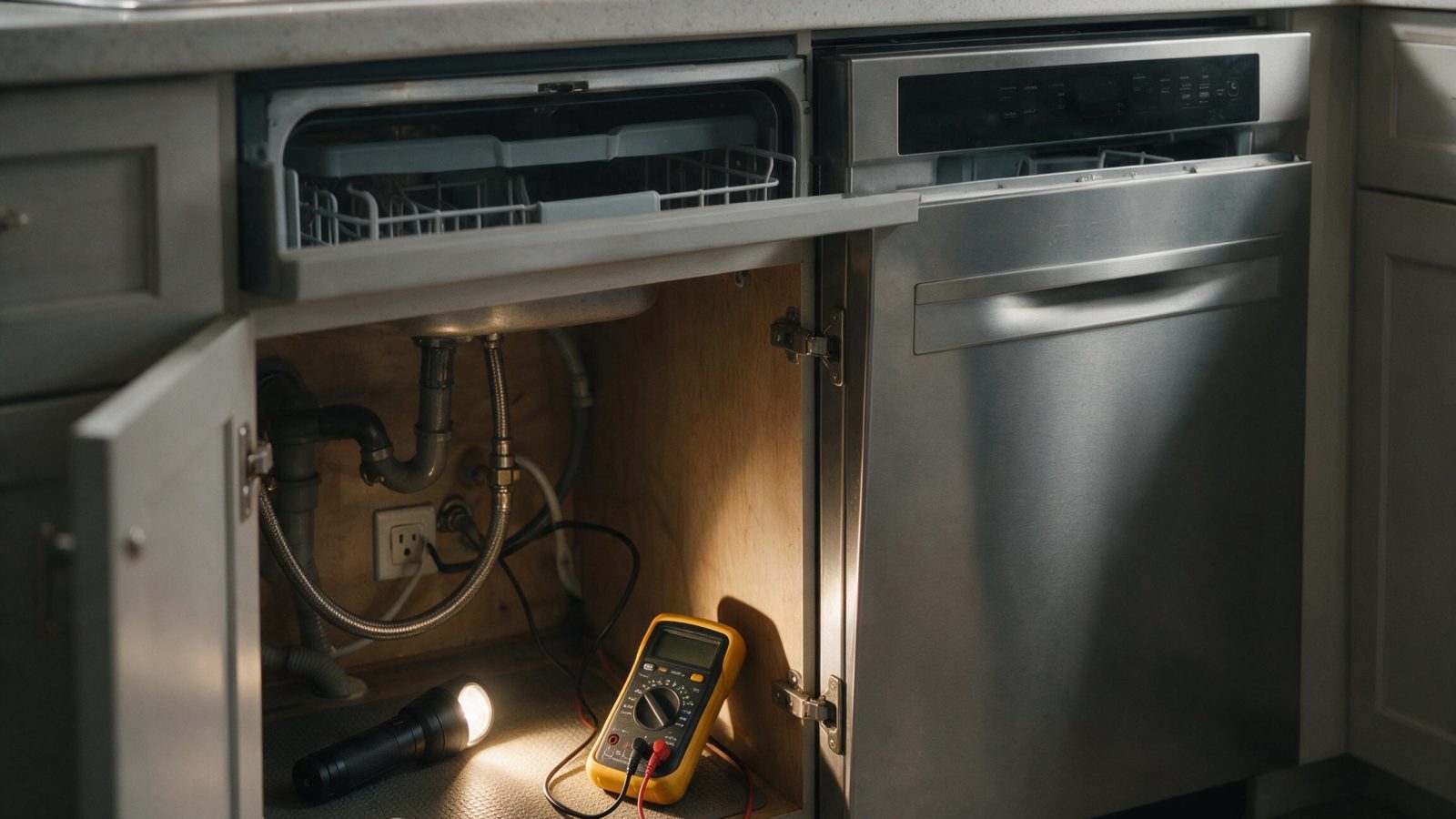
If a GE dishwasher has no lights, tones, display, or response at all, start with the household electrical supply. A tripped breaker, switched outlet, GFCI, loose cord, or junction-box connection can make a healthy dishwasher appear dead.
A completely unresponsive dishwasher is different from one whose panel lights but will not run. When there are no lights and no sound, the first job is to determine whether electricity is actually reaching the appliance.
GE’s own support guidance begins with household power, cord/outlet checks where applicable, and protection features before internal electronic parts are blamed.
Find the breaker supplying the dishwasher and see whether it has tripped.
A breaker can sit near the middle position rather than visibly flipping all the way off. Reset it by moving it fully off and then back on.
If it trips again immediately, stop. Repeatedly resetting a breaker against an active electrical fault can be unsafe.
Some dishwasher installations receive power from an outlet under the sink or in an adjacent cabinet. That outlet may be protected by a GFCI device.
Press the outlet’s reset button if it has tripped.
Also look for another GFCI receptacle on the same circuit that could control the dishwasher outlet.
Not every dishwasher uses a cord, but when one does, the plug can be accidentally disturbed while items are moved under the sink.
Confirm it is fully seated in the receptacle. Do not use an extension cord.
If the outlet is visibly burned, loose, or damaged, leave it unused until an electrician repairs it.
Some kitchens have a wall switch that controls dishwasher power and resembles a light switch or disposal switch.
It can be turned off accidentally, especially after cleaning or electrical work.
Make sure you identify the correct switch and do not confuse it with the garbage disposal control.
If the dishwasher has never powered on since installation, suspect the installation before assuming a new appliance is defective.
A hardwired dishwasher typically has a junction-box connection behind the lower access area. Loose line, neutral, or ground connections are electrical hazards and should be inspected with power off by a qualified person.
GE support specifically recommends checking installation when a newly installed dishwasher has no power.
A loose electrical terminal can create heat and eventually open the circuit.
Warning signs include:
Do not continue troubleshooting with power energized if you see heat damage.
Depending on the dishwasher design, internal protection devices or wiring can interrupt power to the control.
If correct line voltage reaches the dishwasher but the machine is completely dead, the diagnostic path may include:
These checks require the wiring diagram and electrical test equipment.
A failed control can result in a blank panel even when input power is present.
However, “no display” does not automatically mean “bad board.” A dishwasher may have separate main and user-interface boards, and wiring between them can fail.
A proper diagnosis confirms line voltage into the control and verifies low-voltage outputs or communication before parts are ordered.
Control lock can prevent operation, but it generally does not explain a dishwasher with absolutely no signs of electrical life. If the panel is illuminated, use the “won’t start but has power” troubleshooting path instead.
Homeowners can usually reset a breaker, GFCI, wall switch, and accessible plug.
Stop and request qualified service if you need to:
Never bypass a fuse, door switch, or other protective component to force the dishwasher to run.
If the breaker, GFCI, wall switch, and plug are all correct but the dishwasher is still completely dead, internal electrical diagnosis is the next step.
Tell the technician whether the dishwasher is hardwired or plugged in, whether the breaker tripped, and whether there was any recent electrical work, outage, leak, or burning smell.
If you can safely verify that the dishwasher receptacle has power, or an electrician confirms correct voltage at a hardwired connection, the diagnostic boundary moves inside the appliance. A technician can then follow power from the junction box through any thermal protection and into the main control, checking where voltage disappears.
If line voltage reaches the main control but the user interface remains completely blank, the next checks may include low-voltage output, harness continuity, and communication between boards. If line voltage never reaches the control, wiring, a fuse/protector, or a damaged terminal is more likely.
This prevents the common mistake of replacing an expensive electronic board when the actual failure is a loose junction-box connection or tripped upstream device.
Intermittent power deserves more caution than a one-time tripped breaker. A loose junction connection can heat as current flows, then open again. A failing control power supply can also work when cold and stop after warming.
If the dishwasher repeatedly comes back to life after the breaker is cycled, record whether the failure happens during fill, wash, drain, or heated dry. That timing can help identify whether a high-current load or internal control condition is involved. Do not keep cycling power if you smell burning or see heat damage.
If the dishwasher lost power shortly after a leak, do not assume the two events are unrelated. Moisture can reach connectors, the junction area, controls, or leak-protection systems. Disconnect power and correct the water source before repeatedly trying to restart the machine.
A technician should inspect for corrosion or moisture tracking if a power failure followed a leak event. Drying the floor alone does not confirm that internal electrical areas are safe.
The dishwasher may have lost household power, the outlet/GFCI may have tripped, the cord or junction connection may be loose, or an internal power/control component may have failed.
Yes, if the dishwasher’s receptacle is GFCI-protected and that protection trips.
That can indicate an active short, leakage to ground, wiring fault, or failing component. Stop resetting it and arrange electrical/appliance diagnosis.
A failed board can create a blank machine, but incoming power and wiring should be confirmed first.
No. Control lock normally leaves some panel indication or response. A totally dead panel should first be treated as a power-supply problem.
This article covers Ge Dishwasher Has No with practical checks you can run before booking a technician.
Need help now? Visit our services page or contact us.
Official manuals and support notes are available on GE owner support.
Remember: Ge Dishwasher Has No is easier to resolve when you capture the model number and when Ge Dishwasher Has No first appeared.
Write down the full model number before ordering parts. Board and sensor revisions can change which part number is correct.
A single power reset can clear a temporary fault, but repeated returns of the same code usually mean a physical cause remains.
Keep vents and filters clear between visits. Restricted airflow often mimics electrical or sensor failures.
If water, burning smells, or sparking are present, stop using the appliance and arrange a professional inspection.
A GE washer that will not drain may have a kinked hose, installation problem, clogged front-load pump filter, blocked pump, failed drain motor, or…
A GE washer may refuse to spin because the load is unbalanced, water has not drained, the lid or door is not locking, or…
Some vibration is normal during spin, but a GE washer that walks across the floor, bangs the cabinet, or repeatedly stops to rebalance needs…
Request a repair on our homepage booking form, or call us and we’ll help right away.