
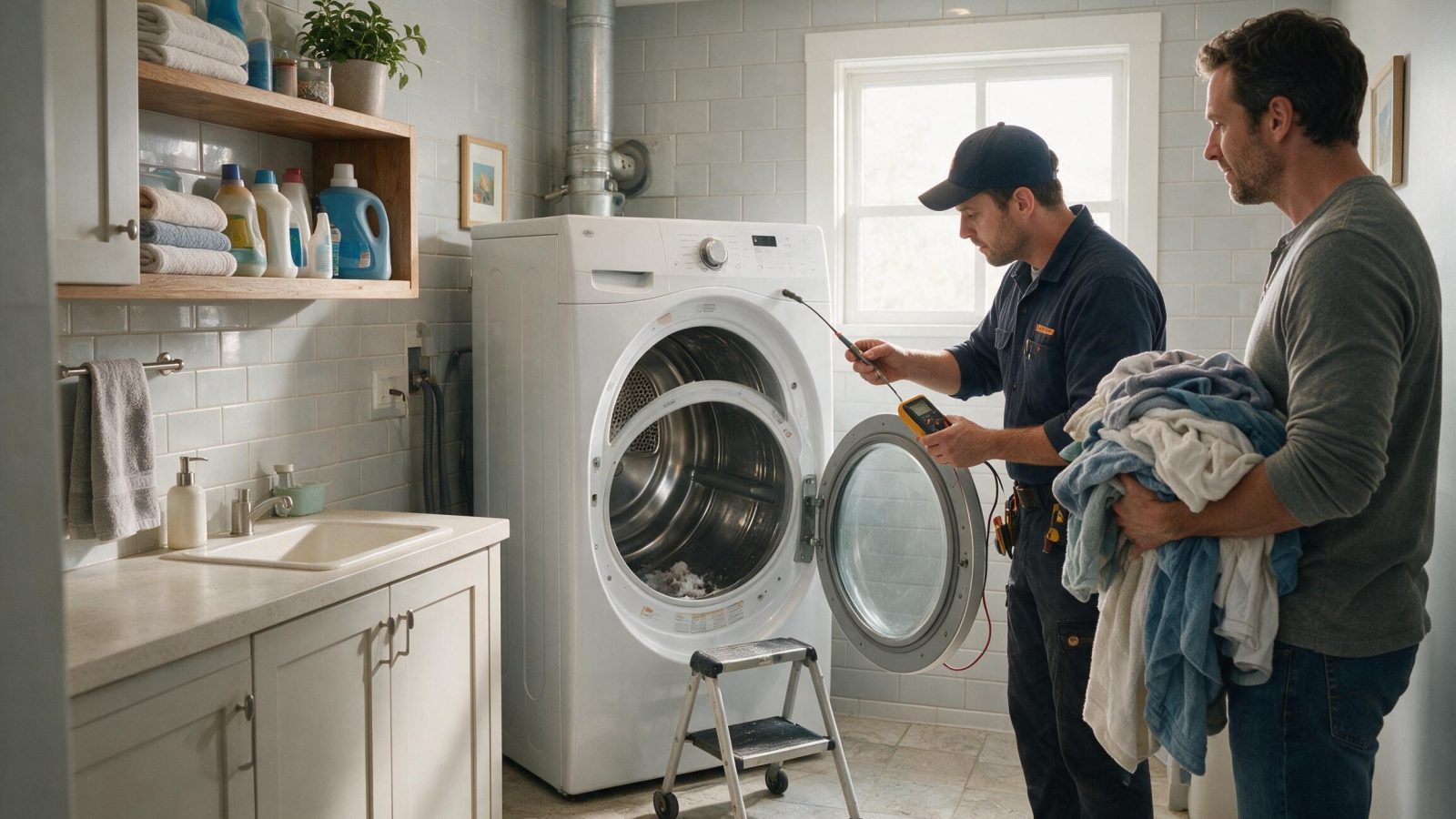
A GE dryer can tumble normally and still produce no heat. Electric and gas models share some checks—cycle selection and airflow—but their heat sources and failure modes are different.
If the drum turns but clothing stays cold and wet, the drive motor is working but the heating system is not doing its job. Before replacing a heating element or igniter, first identify whether the dryer is electric or gas and verify that the selected cycle is supposed to heat.
GE specifically recommends confirming the cycle, fabric setting, and temperature on no-heat complaints.
Air Fluff, Cool Down, or similar unheated settings are designed to tumble without active heat. Select a normal heated cycle and test again.
An electric dryer motor can sometimes run even when the heating circuit has lost part of its electrical supply.
This creates the classic symptom: dryer tumbles but does not heat.
Check the household dryer breaker. Many electric dryers use a double-pole breaker, and one side can trip.
If the breaker will not stay reset, stop and have the circuit and dryer inspected.
GE support notes that a burned, broken, or loose power-cord connection at the rear terminal block can cause heating problems.
Warning signs include:
Turn off the breaker before any inspection. Heat-damaged connections require proper repair, not just tightening a burned terminal.
A gas dryer can tumble with the gas shut off.
Make sure the gas shutoff valve is open and other gas appliances in the home operate normally if applicable.
If you smell gas, stop immediately, avoid electrical switches or flames, leave the area as appropriate, and follow local gas-emergency procedures.
Restricted airflow can cause the dryer to overheat and cycle its burner/heater off quickly. Severe restriction can also open a thermal safety device.
Check:
The outside vent should produce a strong stream of air while the dryer runs.
The heating element can break electrically and produce no heat.
A visual break is not always obvious, so proper testing checks continuity and whether the element is shorted to its housing.
A failed element should be replaced with the correct part for the model.
Gas dryers commonly use an igniter, flame sensor, gas-valve coils, and burner assembly.
Useful observation through an approved viewing area, where provided, may show:
Those patterns point to different components. Do not open a gas line for casual testing.
Dryers use temperature protection to reduce fire risk.
A thermal device can open because of:
If a thermal fuse or cutoff failed, correct the cause of overheating before installing a replacement.
The dryer control relies on thermostats or electronic sensors to regulate heat.
A failed sensor can prevent heat, cause very short heat cycles, or create incorrect temperature behavior.
Testing depends on whether the dryer uses mechanical thermostats, thermistors, or electronic controls.
On some models, the heat circuit is switched through a timer contact or electronic relay.
If the heater, safety devices, and power supply are good but voltage never reaches the heat source, control diagnosis is needed.
Electric tumbles, no heat: breaker/240V supply, cord/terminal block, element, thermal protection, control. Gas tumbles, no heat: gas supply, igniter, flame sensor, valve coils, thermal protection, control. Either type heats briefly then stops: airflow, high-limit cycling, sensor, gas coils, or control. Either type takes forever to dry: check vent restriction before assuming no heat.
Request repair when correct cycle and external airflow checks pass but the dryer still produces no heat, or if electrical/gas components need testing.
Provide the model number, whether it is gas or electric, whether the drum tumbles, and whether you get any heat during the first few minutes.
Without opening the cabinet, you can learn a lot by running a normal heated cycle for several minutes with a small appropriate load. Check whether the exhaust air becomes warm and whether airflow at the exterior vent is strong.
Strong airflow but completely cold exhaust points more toward the heat source or power/gas supply. Very weak airflow with unusually hot cabinet surfaces raises concern for an exhaust restriction. Heat that appears briefly and then disappears can involve high-limit cycling, gas-valve coils, sensors, or control problems.
Do not block the vent to test heat and do not run the dryer with panels removed. The objective is only to observe normal external behavior before electrical or gas service begins.
Run the dryer long enough to determine whether it produces zero heat or only weak/intermittent heat. A completely cold electric dryer with normal tumbling points strongly toward supply or heater-circuit diagnosis. A dryer that becomes hot briefly and then turns cool may be cycling on a high-limit device because airflow is restricted.
On a gas dryer, one successful ignition followed by repeated no-heat periods can point toward a heat-sensitive ignition component. Precise observation of the heat pattern is more useful than replacing the heater or igniter based on one cold load.
If the dryer heats with the exhaust temporarily inspected by a qualified person but performs poorly when connected to the home vent, the building exhaust may be the real problem. Conversely, strong exterior airflow with no heat keeps the focus inside the dryer.
Do not permanently operate a dryer disconnected from its required exhaust system. The purpose of airflow comparison is diagnosis, and any vent configuration must follow the installation instructions and local safety requirements.
Electric models may have lost part of the 240V supply or have a heater/safety fault. Gas models may have a gas-supply or ignition-system problem. Both can also have control or airflow issues.
A partial supply failure can allow the motor circuit to operate while the 240-volt heating circuit does not receive what it needs.
Restricted airflow can make the dryer overheat and cycle off or open a thermal safety device.
A heat-sensitive gas-valve coil or another ignition component can fail after warming, but the complete ignition sequence should be diagnosed.
No. If overheating caused the fuse to open, the airflow or temperature-control cause must also be corrected.
This article covers Ge Dryer Not Heating: with practical checks you can run before booking a technician.
Need help now? Visit our services page or contact us.
Official manuals and support notes are available on GE owner support.
Remember: Ge Dryer Not Heating: is easier to resolve when you capture the model number and when Ge Dryer Not Heating: first appeared.
Write down the full model number before ordering parts. Board and sensor revisions can change which part number is correct.
A single power reset can clear a temporary fault, but repeated returns of the same code usually mean a physical cause remains.
Keep vents and filters clear between visits. Restricted airflow often mimics electrical or sensor failures.
If water, burning smells, or sparking are present, stop using the appliance and arrange a professional inspection.
Electric and gas GE ovens can show the same symptom for very different reasons. Electric models depend on full line voltage and heating elements;…
If the fan, light, display, and turntable operate but food remains cold, first rule out Timer or Demo mode and make sure the door…
If a GE dishwasher has no lights, tones, display, or response at all, start with the household electrical supply. A tripped breaker, switched outlet,…
Request a repair on our homepage booking form, or call us and we’ll help right away.