
Electric and gas GE ovens can show the same symptom for very different reasons. Electric models depend on full line voltage and heating elements; gas models depend on a safe ignition sequence. Start with controls and power, then follow the correct heat-source path.
An oven that stays cold can ruin dinner, but the failure does not always mean the appliance needs a major control board. A tripped half of a double breaker can disable electric heat while the clock still works. A gas oven may have working surface burners but a weak bake igniter that never opens the oven safety valve.
Before troubleshooting, identify whether the appliance is electric, gas, or dual fuel.
Make sure the oven is actually set to Bake or the desired cooking mode and that the temperature was entered correctly.
Check for:
GE notes that electronic oven controls can sometimes be reset by turning the circuit breaker off briefly and restoring power.
Many electric ranges and wall ovens require a 240-volt supply.
The clock and lights may still work with only part of the supply present, so do not assume that an illuminated display proves the heating circuit has full power.
Reset both poles of the breaker. If it trips again, stop and arrange electrical diagnosis.
On models with a visible lower bake element, GE recommends checking for cracks or breaks with power disconnected.
A failed element may show:
Some ovens hide the bake element beneath the oven floor, so absence of a visible element does not mean the oven lacks one.
This symptom strongly narrows the problem to the bake side of the circuit.
Possible causes include:
If neither Bake nor Broil works, supply voltage and common control components become more important.
Working top burners do not prove the oven ignition system is good.
GE specifically recommends checking whether the oven’s glow-bar igniter glows on applicable gas ranges.
Typical patterns:
Do not attempt to manually light a modern oven burner. GE notes that electric-ignition ovens cannot be manually operated during a power outage even if surface burners can sometimes be lit manually.
An oven temperature sensor provides feedback to the control. If it is out of range, the oven may heat incorrectly, cycle abnormally, or generate an error code.
A sensor problem more often causes incorrect temperature than a totally cold oven, but an open/shorted sensor circuit can stop heating on some designs.
Test against model-specific specifications.
The electronic control switches power to electric elements or the gas ignition circuit.
A failed relay may leave one cooking mode dead while the display appears normal.
Before replacing the control, verify:
High-current oven circuits generate significant heat. A loose spade terminal at an element can burn open and mimic a failed element.
Disconnect power before inspection and replace heat-damaged connectors properly. Do not reuse a charred terminal on a new element.
Normal ovens cycle above and below the set temperature to maintain an average cooking temperature. GE explains that this cycling is expected.
If food consistently underbakes or overbakes, compare actual performance over a full cycle rather than reacting to a single thermometer peak.
Calibration may be appropriate if the oven is consistently offset but otherwise heats normally.
GE warns against lining the oven bottom with aluminum foil or silicone liners. These can trap heat, disrupt airflow, damage surfaces, and create safety hazards.
If the oven’s performance problem started after adding a liner, remove it according to safe handling instructions and inspect for damage.
Request service when the breaker and settings are correct but the oven still has no heat, the gas igniter does not complete a safe ignition cycle, or element/control electrical tests are required.
Provide the model number, fuel type, whether Broil works, whether surface burners work on gas models, and whether a visible bake element or igniter heats/glows.
On many ovens, Bake and Broil use different heat circuits. That makes comparison useful. If Broil works strongly but Bake never heats, the bake element/ignition path and its control become more likely than a complete power loss. If neither mode heats while the display works, check common supply, lock/mode settings, and control circuitry.
For a gas range, also compare oven behavior with the surface burners. Surface burners operating normally confirms gas is present at the appliance, but it does not prove the oven’s safety valve and igniter circuit are functioning.
A technician can then test the exact failed branch instead of treating every “oven not heating” complaint as a thermostat problem.
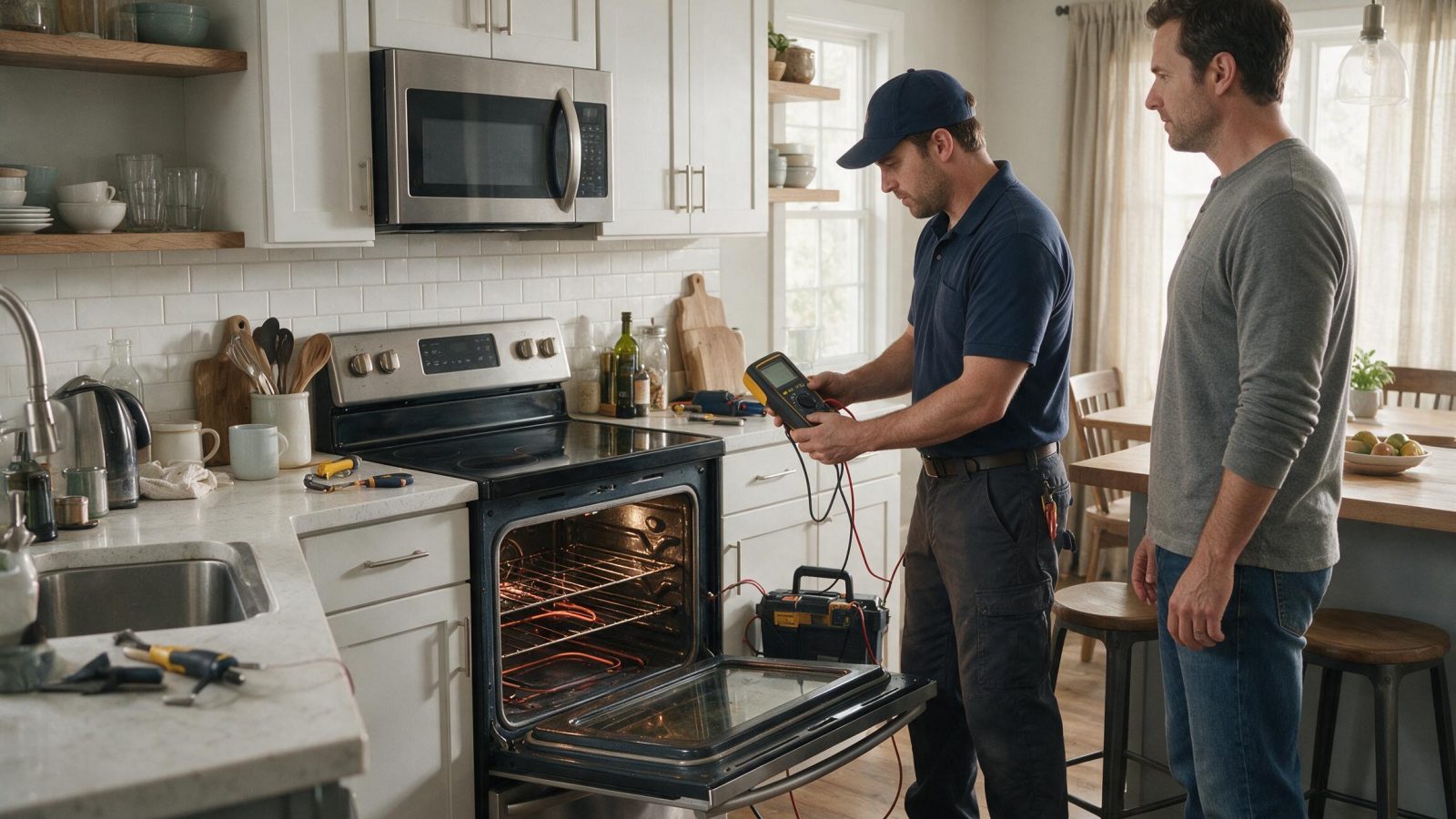
For an electric oven, service can verify full supply voltage, element resistance, wiring continuity, sensor resistance, and whether the control sends voltage to Bake or Broil. For a gas oven, current through the igniter and the ignition sequence are important because an igniter can glow yet still be too weak to open the safety valve reliably.
These measurements distinguish a failed heat source from a control problem and avoid replacing an expensive electronic board when the element, igniter, wiring, or power supply is actually at fault.
Electric ovens can have partial supply loss, failed elements, wiring, sensors, or control relays. Gas ovens can have igniter, gas-valve, or control-circuit faults.
The oven uses a separate ignition and gas-safety system from the surface burners. A weak or failed oven igniter is a common category to test.
Yes. Some low-voltage/control functions may still operate even when the full heating supply is not available.
Ovens cycle heat on and off. GE notes that temperatures normally swing around the set point while maintaining an average.
No for GE electric-ignition oven systems described by the manufacturer. The oven safety/ignition system requires power.
This article covers Ge Oven Not Heating: with practical checks you can run before booking a technician.
Need help now? Visit our services page or contact us.
Official manuals and support notes are available on GE owner support.
Remember: Ge Oven Not Heating: is easier to resolve when you capture the model number and when Ge Oven Not Heating: first appeared.
Write down the full model number before ordering parts. Board and sensor revisions can change which part number is correct.
A single power reset can clear a temporary fault, but repeated returns of the same code usually mean a physical cause remains.
Keep vents and filters clear between visits. Restricted airflow often mimics electrical or sensor failures.
If water, burning smells, or sparking are present, stop using the appliance and arrange a professional inspection.
Some vibration is normal during spin, but a GE washer that walks across the floor, bangs the cabinet, or repeatedly stops to rebalance needs…
If a GE top-load washer fills normally and then sits still, the water-supply system is probably doing its job. The next step is to…
A washer that will not start can be completely dead or powered but unable to begin a cycle. Separate those two symptoms first, then…
Request a repair on our homepage booking form, or call us and we’ll help right away.