
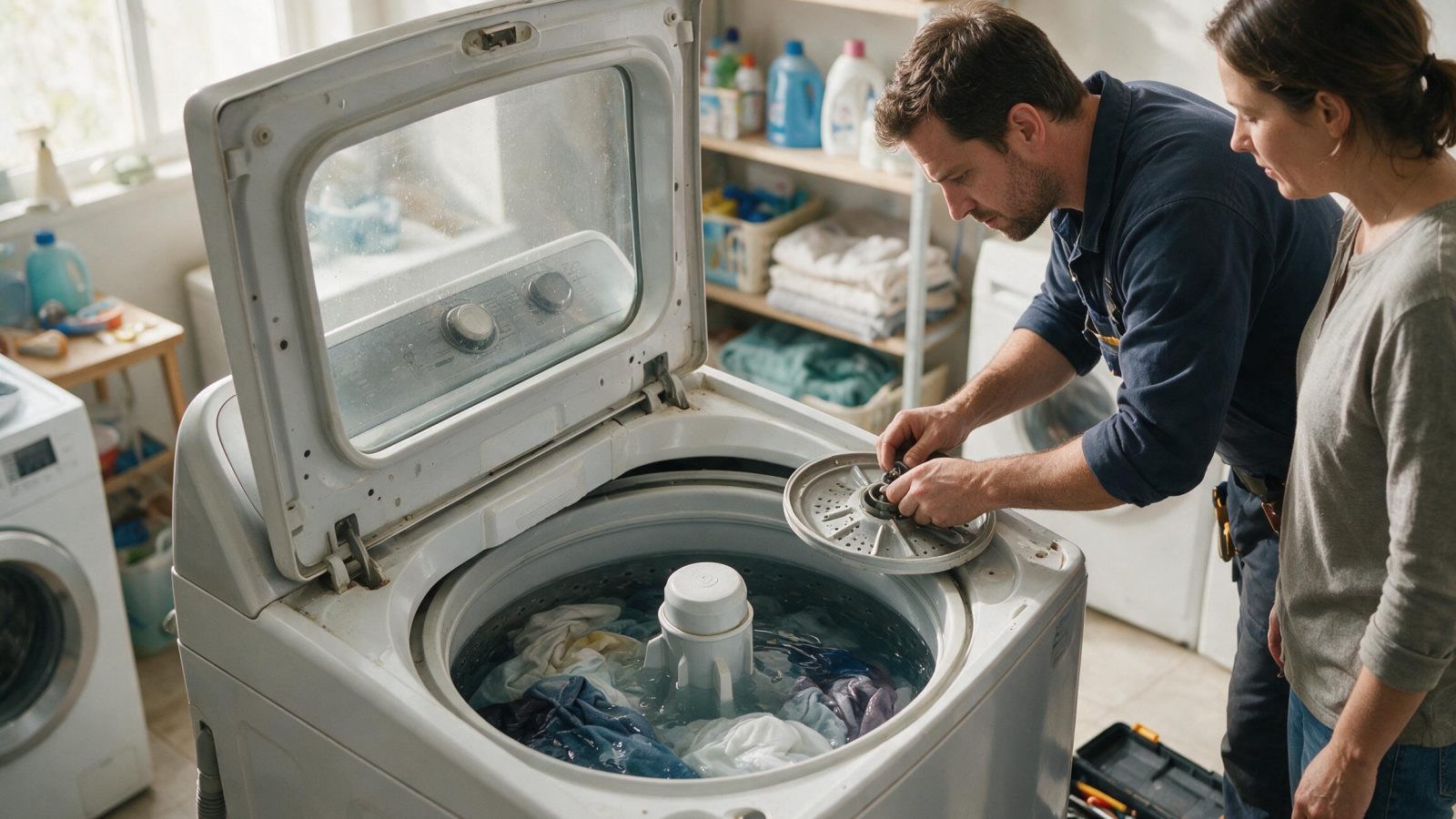
If a GE top-load washer fills normally and then sits still, the water-supply system is probably doing its job. The next step is to determine whether the motor is being commanded to move and whether that motion reaches the basket or agitator.
A washer that fills but does not agitate narrows the diagnosis. The inlet valve, household water supply, and fill sensing are at least functioning enough to reach the wash stage. The fault is now more likely in cycle logic, lid inputs, motor control, or the mechanical drive.
GE has a documented motor-reset procedure for certain top-load washers, but it is not appropriate for every model. Always verify compatibility before using it.
Some modern washers spend time sensing or soaking before obvious agitation begins.
Listen for motor pulses and check the cycle indicator. A quiet sensing period can be mistaken for failure.
If the machine remains inactive well beyond normal cycle behavior, continue troubleshooting.
GE support describes a reset for certain top-load washers that involves disconnecting power briefly and then opening and closing the lid multiple times in a specific period.
This can clear a motor fault caused by a power disturbance or unbalanced-load event on compatible designs.
Do not treat the reset as a universal sequence for every GE washer. Check model documentation first.
If the washer repeatedly needs resetting, diagnose the underlying fault.
Some washers will fill but will not proceed normally if the lid switch or lock signal is missing.
Inspect:
Do not bypass the safety circuit.
Depending on design, the washer may use a traditional agitator or a low-profile wash plate/infusor.
Mechanical splines, couplers, or hubs can wear so the motor moves but the visible wash component does not.
With power disconnected, check for unusual looseness or a component that spins freely when it should engage the drive.
Model-specific parts diagrams help identify the coupling system.
Motor hums but nothing moves: mechanical jam, failed motor/start circuit, or drive problem. Motor sound is normal but agitator slips: coupler/hub/spline issue. No motor sound: control, lock input, wiring, or motor electrical fault. Motor starts and stops abruptly: overload, sensor, control, or binding drive.
The sound pattern helps decide whether to inspect mechanical or electrical components first.
Belt-driven models can lose agitation if the belt breaks, slips, or comes off a pulley.
Look for:
Other washer designs use different transmissions or direct-drive systems, so do not order a belt without checking the model.
Some top-load washers use a mechanism that changes between agitation and spin.
A failure in the gearcase or mode-shifting system can leave one function working and the other missing.
If the washer spins normally but never agitates, this difference is a useful clue.
The control may stop the motor if it does not receive expected rotation feedback.
Symptoms can include jerky movement, repeated start attempts, or a fault code. Model-specific diagnostics may be needed to test the sensor circuit.
Once lock inputs, drive components, and motor circuits are verified, the control becomes a more reasonable suspect.
Confirm that the motor receives the expected command rather than replacing the board based on a silent wash stage alone.
This is one of the best diagnostic questions.
No agitate + normal spin: focus on agitator coupling, mode shifter, cycle control. No agitate + no spin: motor, belt/drive, lock, power, control. Agitator moves weakly: worn drive interface or motor/gearcase issue.
Request service if the model-specific reset does not help, the lock works but the motor will not run, or mechanical drive components need disassembly.
Tell the technician whether the washer spins, whether you hear the motor during wash, and whether the agitator/wash plate has unusual free play.
Modern top-load washers do not always begin obvious back-and-forth agitation immediately after filling. Some pause to soak, sense load conditions, or position the drive system. Before declaring the motor dead, compare the behavior with the selected cycle and listen for relays, lid-lock action, or short motor pulses.
If the washer consistently reaches the same point and then stops, record any status lights or fault code before disconnecting power. A technician can then determine whether the control is waiting for a lid input, seeing a motor fault, or failing to command the drive.
If the machine agitates after a reset but the problem returns, the reset has provided a diagnostic clue rather than a permanent cure. Power disturbances, motor feedback, or a mechanical load may be causing the control to protect itself.
Some wash cycles intentionally pause after filling so detergent can work on the load. If the machine is quiet, look at the cycle selection and status indicators before resetting it. A reset performed during a normal soak can create more confusion than useful information.
If the pause is normal, agitation should begin according to the cycle design. If it never does, then the lid input, motor, drive, and control checks described above become appropriate.
A washer that agitates empty but stalls with a normal load may have a marginal drive component rather than a completely dead motor. Overloading can also cause the drive to protect itself. Test with a small, balanced load that follows the capacity guidance for the machine.
If the agitator or wash plate is difficult to move with power off, or if you hear repeated motor hums under load, stop and inspect for binding or drive wear before continuing to run the washer.
Possible causes include a normal sensing delay, lid-lock problem, motor fault, drive-system failure, control issue, or a motor fault that needs model-appropriate reset/diagnosis.
GE documents a reset procedure for certain top-load models, but it is not universal. Verify the model before using any reset sequence.
The drive system may be able to spin while an agitator coupling, mode-shifter, or gearcase function required for agitation has failed.
On models that require a safe lid status to continue the cycle, yes.
No. Verify lock inputs, drive components, motor operation, and wiring before replacing controls.
This article covers Ge Top Load Washer with practical checks you can run before booking a technician.
Need help now? Visit our services page or contact us.
Official manuals and support notes are available on GE owner support.
Remember: Ge Top Load Washer is easier to resolve when you capture the model number and when Ge Top Load Washer first appeared.
Write down the full model number before ordering parts. Board and sensor revisions can change which part number is correct.
A single power reset can clear a temporary fault, but repeated returns of the same code usually mean a physical cause remains.
Keep vents and filters clear between visits. Restricted airflow often mimics electrical or sensor failures.
If water, burning smells, or sparking are present, stop using the appliance and arrange a professional inspection.
If a GE dishwasher has no lights, tones, display, or response at all, start with the household electrical supply. A tripped breaker, switched outlet,…
The location of a dishwasher leak matters. Water from the door points toward different causes than water under the cabinet or at the sink…
Poor wash results are often a system problem rather than one failed part. The dishwasher needs hot water, correct detergent chemistry, adequate fill, unrestricted…
Request a repair on our homepage booking form, or call us and we’ll help right away.