
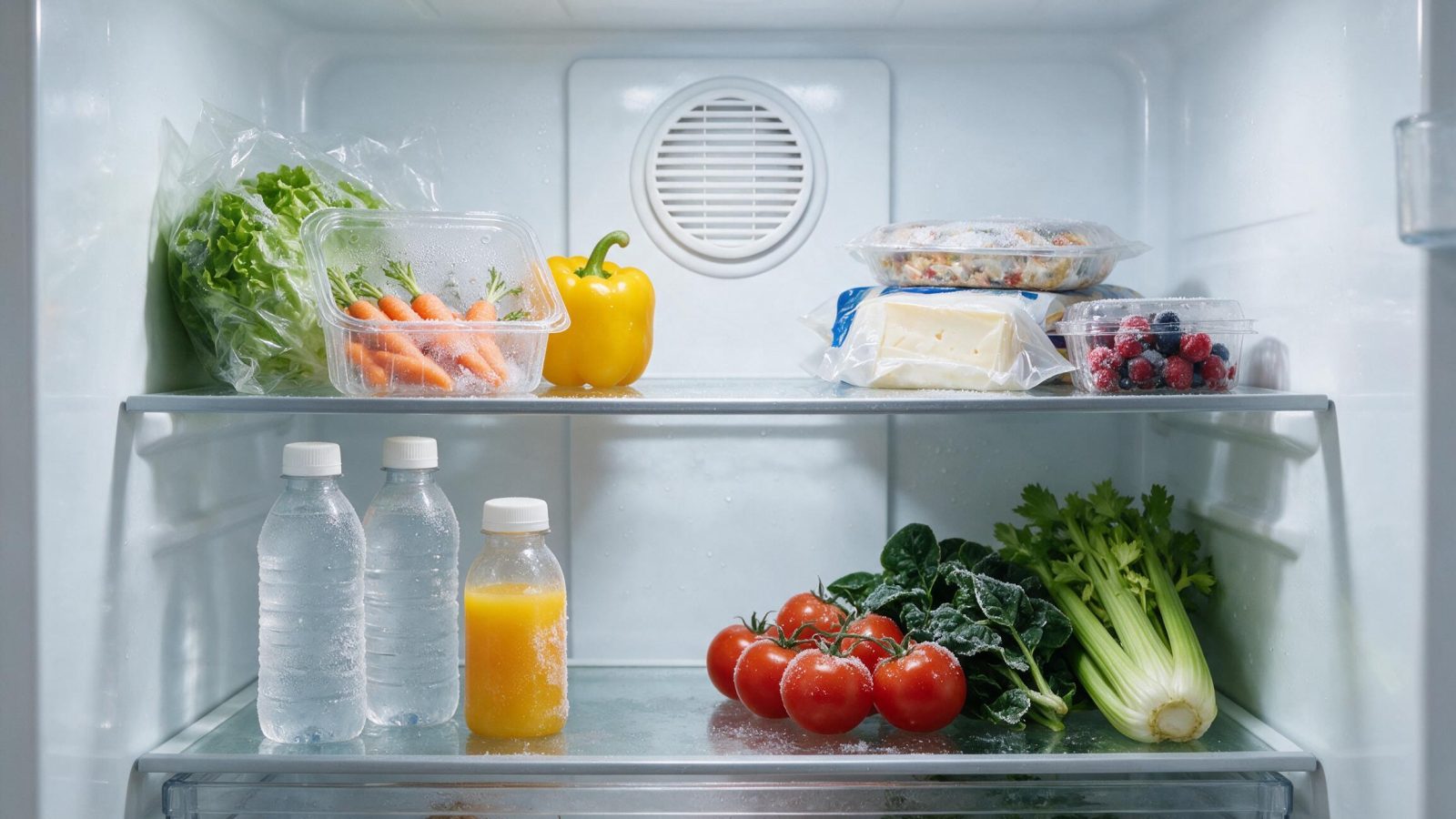
Frozen lettuce, milk, or produce in the refrigerator section does not always mean the whole refrigerator is too cold. Airflow location, damper position, sensor feedback, and food placement can create local freezing even when the display looks normal.
A refrigerator is supposed to keep food safely cold without turning the fresh-food section into a freezer. When produce, drinks, or dairy items freeze, start by finding out whether the entire compartment is too cold or only a specific shelf or drawer.
That difference points toward either a global temperature-control problem or a local airflow problem.
Place a reliable refrigerator thermometer near the center of the fresh-food compartment, away from a vent or wall.
If the average temperature is close to the normal target but food near one vent freezes, the issue may be placement or airflow concentration.
If the entire compartment is far below the set point, investigate controls, sensors, and dampers.
Make sure the control was not accidentally changed. Digital displays can be altered during cleaning, loading, or by pressing adjacent controls.
Return the setting to the recommended range for the model and allow enough time for the cabinet to stabilize before changing it again.
Repeatedly moving the control warmer and colder can hide the real pattern.
The air entering from the cooling system can be significantly colder than the compartment average.
Leafy vegetables, eggs, dairy products, and drinks placed directly in that airstream may freeze while the rest of the refrigerator remains normal.
Avoid placing temperature-sensitive food directly against:
Use drawers for produce if the model is designed for them.
Blocking return-air passages can distort circulation and produce hot and cold zones.
A tightly packed refrigerator may force cold air into one area while preventing it from mixing through the compartment.
Rearrange shelves so supply and return pathways remain open.
The damper meters cold air entering the refrigerator section from the cooling area.
If it sticks open, the refrigerator can receive too much freezer air and begin freezing food.
Possible causes include:
A damper problem is especially likely if food freezes near the air inlet and adjusting the fresh-food setting has little effect.
Electronic controls rely on sensors to estimate cabinet temperature.
If the fresh-food thermistor reports a falsely warm reading, the control may continue to request cooling even after the compartment is already cold enough.
Proper thermistor diagnosis involves comparing resistance or diagnostic data to actual temperature. Guessing based on symptoms alone can lead to unnecessary parts replacement.
A control that continues powering cooling components after the target temperature is reached can overcool the cabinet.
Before replacing a board, confirm:
Electronic boards are expensive and should be the conclusion of testing, not the first suspect.
A poor door seal usually makes a refrigerator too warm, but it can also create frost and airflow changes that lead to uneven temperatures.
Inspect gaskets for gaps and look for excessive condensation or frost near the door opening.
Correct sealing problems before diagnosing more complex temperature-control components.
An almost empty refrigerator can have larger local temperature swings because there is less stored thermal mass. An overfilled refrigerator can have poor circulation.
Aim for reasonable spacing rather than packing food against every wall and vent.
Only produce near back wall freezes: placement or concentrated cold airflow. Everything freezes: setting, sensor, damper, or control issue. Food freezes near one vent: damper/airflow direction. Temperatures swing from warm to freezing: sensor, airflow, fan, or control instability. Fresh food freezes while freezer has heavy frost: inspect airflow and defrost system.
Do not permanently block an air vent with tape or foam to stop freezing. The vent is part of the designed airflow system, and blocking it can create a warm refrigerator or moisture problems elsewhere.
Do not place a heater inside the cabinet or use sharp objects to remove ice.
Request a diagnosis when the entire refrigerator section remains too cold after the setting is corrected, when the damper appears stuck, or when sensor/control testing is required.
Provide the model number, set temperature, measured temperature, and the exact locations where food freezes. A pattern such as “only items on the top rear shelf freeze” is diagnostically useful.
A simple shelf map can make this complaint much easier to diagnose. Place temperature-safe containers or thermometers in several zones—upper rear, lower front, center shelf, and drawer area—and compare them after the refrigerator has operated normally for several hours. Do not place the sensors directly against the wall or in the path of an air jet unless you are intentionally measuring that cold spot.
If only one location is freezing while the center of the compartment is normal, airflow direction and food placement deserve priority. If every zone is substantially colder than the selected setting, a sensor, damper, or control problem becomes more plausible.
This also helps after a repair. A corrected refrigerator should not merely stop freezing one carton of milk; cabinet temperatures should become more consistent across the fresh-food section.
A refrigerator that seems fine most of the year but freezes food during colder weather may be reacting to changes in room temperature, airflow, or how often the doors are opened. Likewise, moving the appliance closer to an exterior wall, heating vent, or another appliance can alter local conditions around the cabinet.
If the symptom is seasonal, record the room temperature and whether compressor run time changed. That context helps separate a true sensor/damper failure from an installation condition that only appears under certain ambient temperatures.
Produce may be too close to a cold-air outlet, the refrigerator may be set too cold, or a damper/sensor problem may be overcooling the compartment.
The display may show the set point rather than the exact temperature at every shelf. Local airflow or incorrect sensor feedback can still create freezing zones.
Yes. A sensor that reports the wrong temperature can cause the control to request excessive cooling.
No. Blocking designed airflow can cause other temperature and moisture problems. Move food and diagnose the airflow control instead.
Depending on the model, the damper assembly may be serviced or replaced. Diagnosis should confirm that it is not simply obstructed by ice or food.
This article covers Ge Refrigerator Freezing Food with practical checks you can run before booking a technician.
Need help now? Visit our services page or contact us.
Official manuals and support notes are available on GE owner support.
Remember: Ge Refrigerator Freezing Food is easier to resolve when you capture the model number and when Ge Refrigerator Freezing Food first appeared.
Write down the full model number before ordering parts. Board and sensor revisions can change which part number is correct.
A single power reset can clear a temporary fault, but repeated returns of the same code usually mean a physical cause remains.
Keep vents and filters clear between visits. Restricted airflow often mimics electrical or sensor failures.
If water, burning smells, or sparking are present, stop using the appliance and arrange a professional inspection.
If a GE top-load washer fills normally and then sits still, the water-supply system is probably doing its job. The next step is to…
A washer that will not start can be completely dead or powered but unable to begin a cycle. Separate those two symptoms first, then…
A GE dryer can tumble normally and still produce no heat. Electric and gas models share some checks—cycle selection and airflow—but their heat sources…
Request a repair on our homepage booking form, or call us and we’ll help right away.