
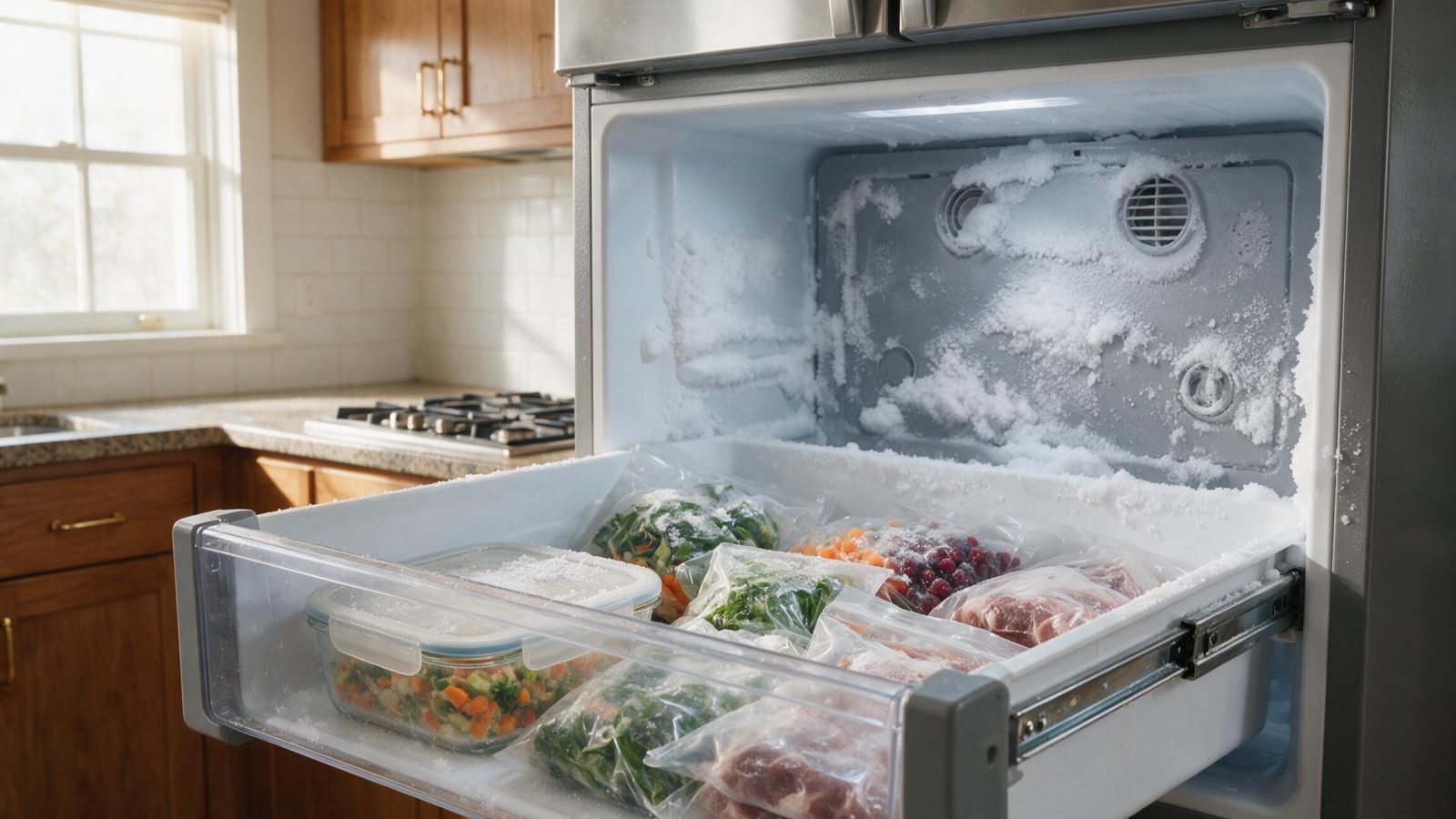
A thin film of frost in the right place can be normal, but thick snow or ice on the freezer wall is a warning. The pattern helps distinguish humid-air intrusion from a failed automatic defrost system.
Frost is not a diagnosis by itself. Moisture enters a freezer every time the door opens, and the appliance is designed to manage that moisture. The problem begins when frost accumulates faster than the normal defrost system can remove it or when warm, humid air continuously enters through a door leak.
The most important clue is where the frost forms.
A thick, even layer of white frost on the interior rear panel often suggests that the evaporator behind that panel is icing over.
As the ice layer grows, airflow through the evaporator decreases. The fresh-food section may warm first because less cold air reaches it, while the freezer can stay cold for a while.
Potential defrost-system causes vary by model and may include:
A technician can expose the evaporator, inspect the frost pattern, and test the circuit rather than guessing which part is responsible.
Frost concentrated near the door opening points more strongly toward humid room air entering the freezer.
Check for:
Clean the gasket and the cabinet surface it contacts. A seal that is dirty can leak even when it is not torn.
If a freezer door was left ajar for several hours, a large frost event may occur without any failed part.
Remove food as needed, restore proper closure, and allow the refrigerator to recover. If frost returns during normal use, look for a persistent sealing or defrost problem.
Ice can accumulate around the fan and produce scraping, buzzing, or rattling sounds. When the blade strikes ice, airflow can fall sharply.
Do not let the fan grind against ice for days. The underlying problem could be a defrost failure or air leak, and the fan motor can also be damaged.
Overpacking can reduce circulation and create local cold/humid zones. Keep food away from air vents and do not block return paths.
A blocked vent alone may not cause a full evaporator freeze-up, but poor airflow can worsen temperature imbalance and frost symptoms.
Yes, but the symptom is usually more ice or water near the freezer floor rather than only white frost on the rear wall.
A clogged defrost drain can cause meltwater to refreeze under baskets or leak onto the floor. GE specifically documents ice under the bottom freezer basket as a clue on some side-by-side models.
A full thaw can restore airflow if the evaporator is blocked with ice. If cooling returns to normal and then gradually deteriorates again over days or weeks, that pattern strongly supports an unresolved defrost or moisture-entry problem.
Never use a knife, screwdriver, or other sharp tool to speed the process. Refrigerant tubing behind the freezer liner can be punctured.
During normal refrigeration, moisture freezes on the evaporator. Periodically, the refrigerator pauses active cooling and warms the evaporator enough to melt that frost. Water then drains to a pan where it can evaporate.
If any part of that sequence fails, ice accumulates:
1. heater does not warm the evaporator; 2. sensor does not correctly detect temperature; 3. control never initiates or completes defrost; 4. drain does not carry water away; 5. door leak adds more moisture than the system can manage.
Understanding the sequence helps prevent random parts replacement.
If safe to do so, take a photo before thawing the refrigerator. Once the ice is gone, the original frost pattern disappears and valuable diagnostic evidence is lost.
A uniform block of frost, a small isolated frost patch, and ice concentrated only near a door do not point to the same failure.
Request a diagnosis if frost repeatedly returns, airflow falls, the fresh-food section warms, a fan strikes ice, or the refrigerator cannot complete normal defrost operation.
Include the model number and a photo of the frost location. Mention whether the refrigerator section is also warming and whether you hear fan scraping.
When recurring frost points toward the evaporator, the next step is not automatically a new heater. A technician can test whether the heater has electrical continuity, whether the defrost sensor or thermostat changes state at the expected temperature, whether wiring is intact, and whether the control actually sends power during a commanded defrost.
The frost pattern itself is also valuable. An evaporator buried uniformly in snow suggests a different problem from a coil with frost on only a small section. The second pattern can indicate weak refrigeration capacity rather than a simple defrost failure.
For this reason, photograph the evaporator-area frost before a complete thaw whenever it is safe and accessible to do so. Once the refrigerator has been unplugged long enough to melt everything, that diagnostic evidence is gone.
Once the underlying fault is fixed, reduce new moisture entry. Make sure drawers and doors close without interference, wipe sticky gasket surfaces, and avoid leaving the freezer open while organizing food. Do not pack items against the rear evaporator cover or air vents.
If the refrigerator was recently moved, confirm it sits correctly and the doors self-close as intended by the installation instructions. A technically healthy defrost system can still struggle if the cabinet is repeatedly exposed to humid room air through a poor seal.
A freezer basket, ice bin, or food package can sit slightly out of position and keep the door from sealing even though the handle looks closed. After reorganizing the freezer, close the door slowly and verify that nothing contacts the liner or gasket. If frost began after a drawer was removed for cleaning, make sure it was reinstalled on its tracks correctly.
This is a simple but important check because a constant small air leak can create enough moisture to mimic a defrost-system problem.
A recurring, heavy rear-wall frost pattern can indicate that the evaporator is not defrosting correctly, though door leakage and airflow conditions should also be checked.
Yes. Warm, humid air entering around a poor seal condenses and freezes inside the compartment.
It can melt existing ice, but a failed heater, sensor, control, or sealing problem will allow frost to return.
A clogged defrost drain can allow water to collect and refreeze at the freezer floor on some designs.
No. Sharp tools can puncture hidden evaporator tubing or damage the liner.
This article covers Ge Refrigerator Frost Buildup with practical checks you can run before booking a technician.
Need help now? Visit our services page or contact us.
Official manuals and support notes are available on GE owner support.
Remember: Ge Refrigerator Frost Buildup is easier to resolve when you capture the model number and when Ge Refrigerator Frost Buildup first appeared.
Write down the full model number before ordering parts. Board and sensor revisions can change which part number is correct.
A single power reset can clear a temporary fault, but repeated returns of the same code usually mean a physical cause remains.
Keep vents and filters clear between visits. Restricted airflow often mimics electrical or sensor failures.
If water, burning smells, or sparking are present, stop using the appliance and arrange a professional inspection.
If a GE top-load washer fills normally and then sits still, the water-supply system is probably doing its job. The next step is to…
A washer that will not start can be completely dead or powered but unable to begin a cycle. Separate those two symptoms first, then…
A GE dryer can tumble normally and still produce no heat. Electric and gas models share some checks—cycle selection and airflow—but their heat sources…
Request a repair on our homepage booking form, or call us and we’ll help right away.