
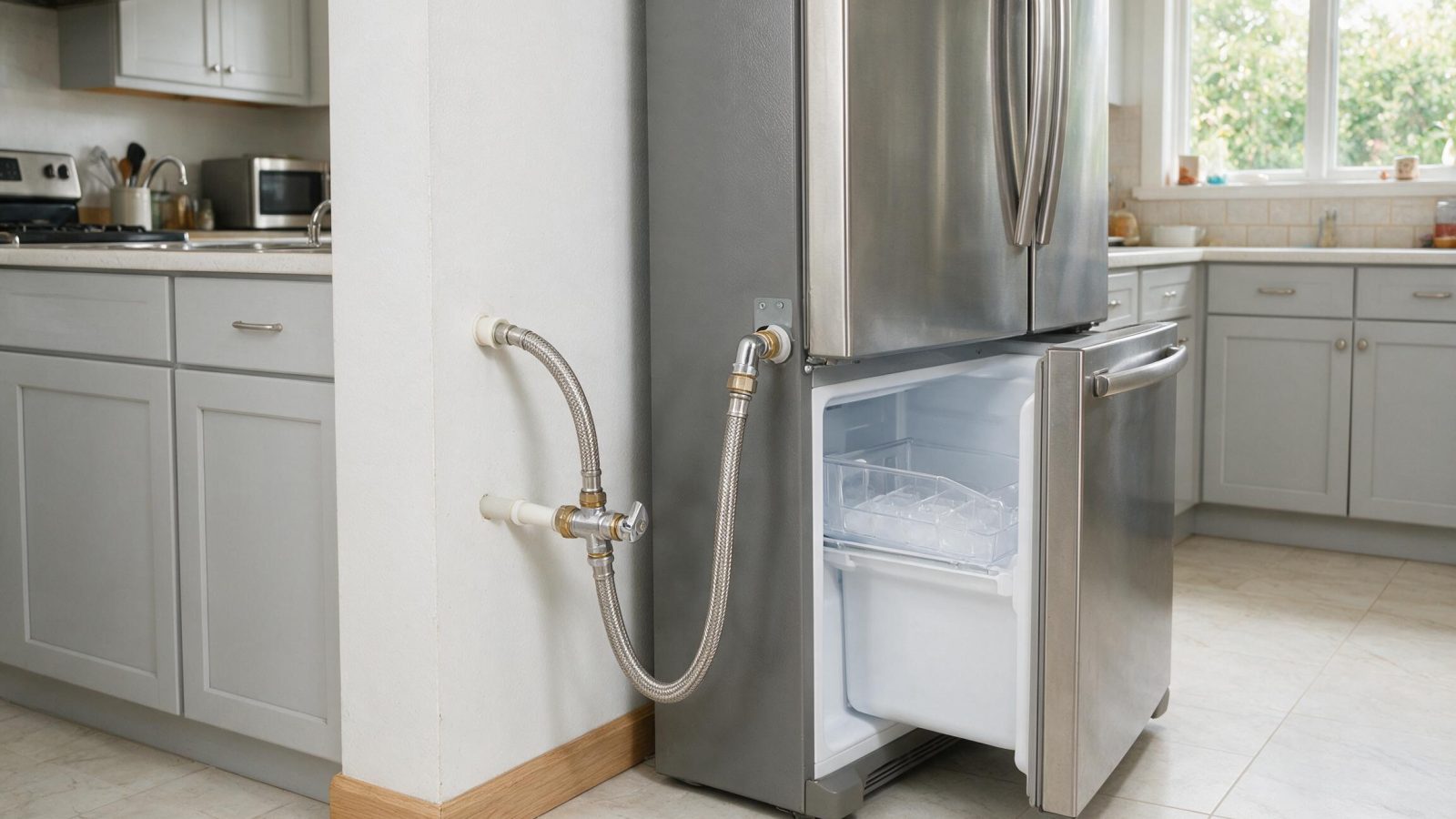
An ice maker that cycles but stays dry has a narrower problem than an ice maker that never moves. Trace the fill circuit from the household supply through the filter, inlet valve, and fill tube before replacing the ice maker.
If the ice-maker mold is empty and you never hear water enter after a harvest cycle, the water-delivery system becomes the focus. GE refrigerators may use separate valve outlets for the dispenser and ice maker, so a working water dispenser does not automatically prove that the ice maker’s fill circuit is healthy.
Before testing the plumbing, make sure the ice maker is turned on and the bin-level arm or sensor is not indicating “full.”
GE ice-maker controls vary by refrigerator family, so use the exact model instructions.
An ice maker may refuse to cycle if the freezer is too warm. If it never reaches the point where it commands a fill, there may be nothing wrong with the water system.
Measure temperature rather than assuming that frozen food means the compartment is cold enough.
Open the household shutoff valve fully. Inspect the supply line behind the refrigerator for crushing or sharp bends.
If the dispenser also has weak or zero flow, focus on:
A clogged filter can starve both the dispenser and ice maker. If the filter is overdue or flow has gradually weakened, replace it with the model-correct cartridge.
After installing a filter, purge trapped air according to the owner’s manual.
A frozen fill tube is one of the most direct reasons an ice maker receives no water.
If accessible, look for ice inside or around the tube where it enters the ice-maker fill cup.
Repeated freeze-ups often mean more than “the freezer is too cold.” A seeping inlet valve can let a small amount of water remain in the tube between cycles, where it freezes and blocks the next fill.
The inlet valve contains one or more electrically operated solenoids. When the ice maker calls for water, the correct valve circuit should open for a controlled fill period.
A valve can fail in several ways:
Testing may require meter readings and confirming voltage during a fill command. Use model-specific service information and appropriate electrical safety procedures.
This comparison is extremely useful:
Dispenser also has no water: shared supply or filter issue becomes more likely. Dispenser works strongly: the refrigerator has water, so inspect the ice-maker valve outlet, fill tube, and command circuit. Dispenser flow is weak: filter, pressure, or supply restriction can still be the root cause.
Yes. The ice maker itself may mechanically cycle but fail to close the internal contact or send the electronic request that powers the inlet valve.
Depending on design, the fault may be in:
The correct test is to determine whether the valve receives its fill command, not to replace both valve and ice maker at once.
Before water stops completely, reduced fill often shows up as undersized or hollow cubes.
That points toward restricted water volume rather than a purely mechanical harvesting problem.
Check filter age, pressure, tubing, and valve condition if cube size changed before production stopped.
The refrigerator valve is designed to operate within a specified pressure range. Very low pressure can reduce fill volume and may contribute to improper valve closing.
If the refrigerator is connected through a restrictive saddle valve, reverse-osmosis system, or clogged whole-house filter, the appliance may not receive adequate flow even though water is technically present.
Follow installation specifications for the refrigerator and any connected treatment system.
Homeowners can usually check supply valves, tubing, filter installation, visible ice, and control settings.
Stop and schedule service when diagnosis requires:
If the freezer is at the correct temperature, the ice maker cycles, the household water supply is good, and the fill tube is clear but no water enters, valve or command-circuit diagnosis is the logical next step.
When booking, report whether the dispenser works, whether the ice maker ever cycles, and whether the fill tube contains ice. These details help distinguish supply, valve, and control faults.
A controlled fill test can answer several questions quickly. Does the ice maker reach the point in its cycle when it should request water? Does the control send power to the correct valve coil? Does water leave the valve but fail to reach the fill cup? Is the fill volume too low because of pressure or restriction?
Those results separate command problems from plumbing problems. Voltage at the valve with no water flow suggests a valve, supply, or line restriction. No voltage during a valid fill request points toward the ice-maker module, wiring, or control. Water leaving the valve but not reaching the mold suggests a frozen, disconnected, or obstructed fill path.
This matters because a dispenser that works normally can mislead owners into assuming the entire inlet-valve assembly is healthy. Multi-outlet valves and separate tubing branches can fail independently.
Timing can point directly to the cause. If the ice maker stopped filling after a filter change, look first at filter installation and air purging. If it stopped after the refrigerator was moved, inspect the supply line for a kink or closed shutoff. If the fill tube began freezing after an inlet-valve replacement, verify the correct valve and water-pressure conditions.
A fault that begins immediately after another change is often related to that change. Establishing the timeline prevents unrelated components from being replaced.
The ice maker can have a separate valve outlet, frozen fill tube, or control fault even when the dispenser circuit works normally.
Yes. A valve that seeps after closing can allow water to freeze in the fill tube. The tube should not simply be thawed repeatedly without finding the reason.
Low pressure can reduce fill volume and interfere with proper valve operation.
Yes. Ice-making logic depends on freezer/ice-maker temperature. A warm freezer can prevent normal cycling and fill commands.
Many refrigerators use a multi-outlet valve assembly, but exact plumbing varies by model.
This article covers Ge Refrigerator Ice Maker with practical checks you can run before booking a technician.
Need help now? Visit our services page or contact us.
Official manuals and support notes are available on GE owner support.
Remember: Ge Refrigerator Ice Maker is easier to resolve when you capture the model number and when Ge Refrigerator Ice Maker first appeared.
Write down the full model number before ordering parts. Board and sensor revisions can change which part number is correct.
A single power reset can clear a temporary fault, but repeated returns of the same code usually mean a physical cause remains.
Keep vents and filters clear between visits. Restricted airflow often mimics electrical or sensor failures.
If water, burning smells, or sparking are present, stop using the appliance and arrange a professional inspection.
If a GE top-load washer fills normally and then sits still, the water-supply system is probably doing its job. The next step is to…
A washer that will not start can be completely dead or powered but unable to begin a cycle. Separate those two symptoms first, then…
A GE dryer can tumble normally and still produce no heat. Electric and gas models share some checks—cycle selection and airflow—but their heat sources…
Request a repair on our homepage booking form, or call us and we’ll help right away.