
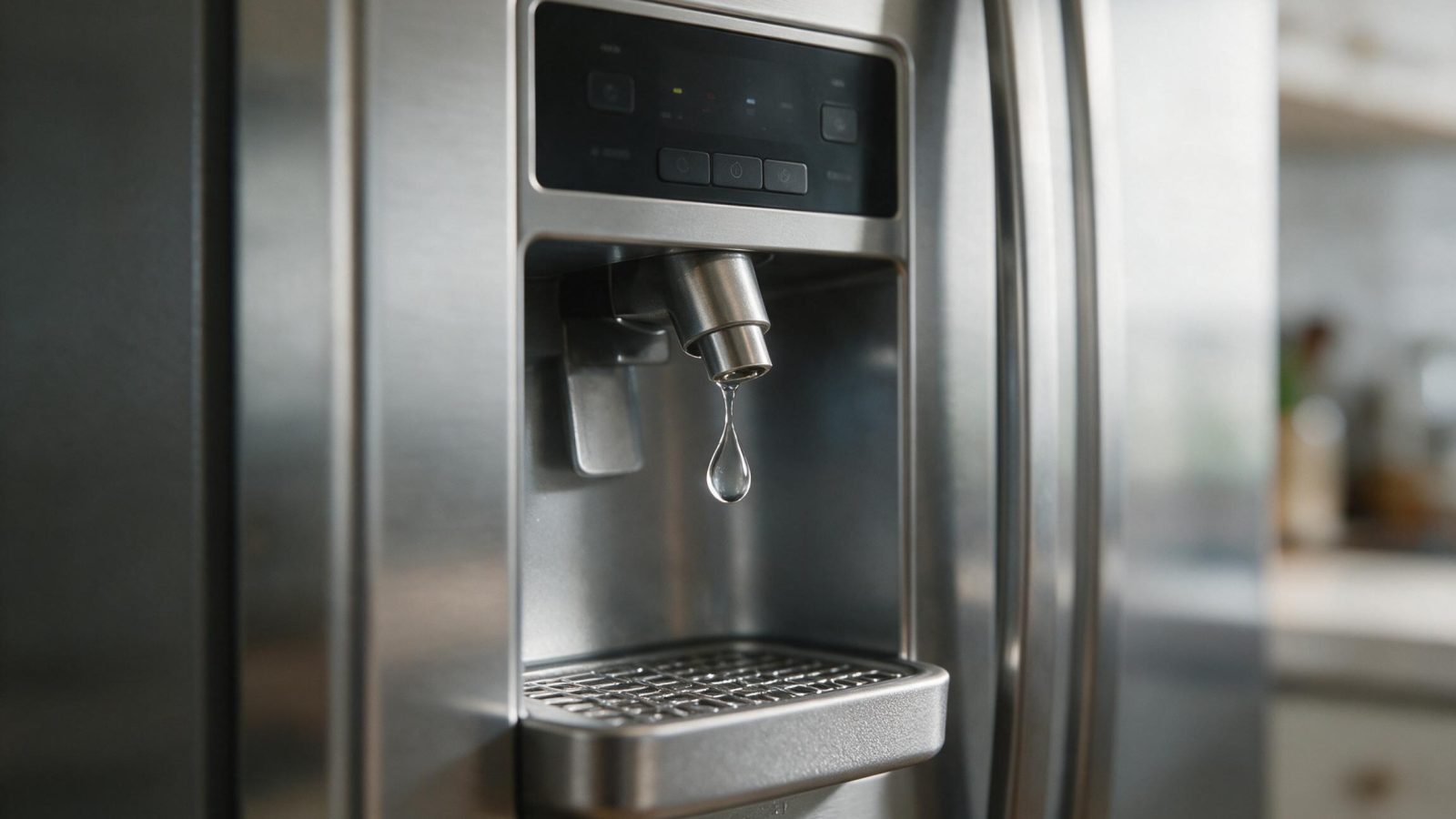
A couple of residual drops after filling a glass can be normal. A dispenser that continues to drip, leaks between uses, or creates a puddle needs the water system checked for air, pressure, filter, valve, and tubing problems.
A refrigerator dispenser leak can be minor at first and still cause staining, slippery flooring, or moisture damage if it continues. The key diagnostic question is whether the dispenser drips only immediately after use or keeps leaking when nobody has touched it.
Water left in the end of the dispenser tube may release a drop or two after the paddle is released. That is different from a steady drip every few minutes.
Persistent dripping indicates that water is still moving through the system or draining from trapped air pockets.
If the leak started after replacing the filter or connecting the refrigerator to water, air trapped in the system is one of the first things to address.
Air can make flow sputter and allow water to move unpredictably after the dispenser paddle is released.
Use the model-specific GE instructions to flush the dispenser. GE support commonly instructs owners to dispense a substantial quantity of water after certain filter or installation procedures to remove air.
A filter that is not fully seated can create pressure and sealing problems.
Remove and reinstall it only according to the owner’s manual. Confirm:
If moisture appears around the filter housing rather than the dispenser outlet, the filter circuit may be the actual source of the leak.
The refrigerator inlet valve relies on water pressure to operate properly. Pressure that is too low can sometimes keep a valve from closing as decisively as intended.
Look for broader plumbing symptoms such as weak flow at nearby fixtures. Also inspect for a partially closed shutoff valve or a heavily restricted supply connection.
Do not increase pressure blindly; household water pressure must remain within safe plumbing and appliance requirements.
A worn or contaminated valve seat can allow water to seep through after electrical power to the solenoid has stopped.
Clues include:
Because the valve is connected to both electricity and pressurized water, diagnosis should include leak testing and electrical checks.
The end of the water tube should be correctly positioned in the dispenser assembly. If it is loose, cracked, or pushed out of place, water can run behind the trim instead of cleanly into the glass.
This can look like a “drip” even when the valve is closing normally.
Inspect visible tubing without prying decorative panels. If water is emerging from behind the dispenser housing, panel removal may be needed.
A partially frozen line can reduce flow to a narrow stream and contribute to odd post-dispense behavior.
If the refrigerator is also freezing food or running unusually cold, solve the temperature problem rather than repeatedly thawing the dispenser tube.
A line that freezes again after thawing indicates an underlying airflow or temperature-control issue.
Plastic tubing can develop a split, particularly at a bend or fitting. A crack may leak only while the dispenser is running, making it easy to miss.
Look for moisture inside the door, beneath hinges, under drawers, or behind the refrigerator after dispensing a glass of water.
Shut off the water supply if an internal line is actively leaking.
Dry the dispenser outlet completely, then dispense a glass of water and observe it for ten to fifteen minutes.
Modern dispenser assemblies contain switches, user-interface components, lights, and wiring. If water is entering the control area rather than falling from the nozzle, shut off the refrigerator’s water supply and arrange service.
Repeated moisture exposure can turn a small plumbing problem into an electrical repair.
Schedule a diagnosis when purging air and correcting filter installation do not stop the drip, when the valve appears to seep continuously, or when the leak comes from inside the dispenser housing or door.
Tell the technician whether the leak is from the nozzle, filter housing, door, or rear tubing and whether it occurs only while dispensing or continues at rest.
After the leak is corrected, pay attention to the conditions that created it. Use the filter specified for the refrigerator and seat it fully rather than forcing the cartridge. After water-system service, purge air using the model instructions instead of assuming sputtering will disappear on its own. Keep the household shutoff fully open so the inlet valve receives normal supply pressure.
If a frozen line caused the symptom, verify that the refrigerator is not running unusually cold and that food is not blocking airflow around temperature sensors or vents. Repeatedly thawing the same tube without correcting the temperature or valve issue is not a long-term fix.
For an inlet valve that seeped, inspect the fill/dispenser system for secondary evidence such as ice accumulation or water staining. A slow leak can affect more than the dispenser recess.
Confirm that the dispenser drip truly continues after the water system has been fully purged. A valve that is blamed too early may be operating normally while trapped air or a poorly seated filter is still changing pressure in the line. Also compare dispenser flow with the refrigerator’s previous normal flow. A weak stream plus dripping suggests a different problem from a strong stream that simply will not stop cleanly.
If the refrigerator has recently been moved, inspect the supply tube behind it for a partial kink. A restriction can create unusual pressure behavior and may be easy to correct without touching internal parts.
A small amount of residual dripping can occur, but repeated or continuous dripping should be investigated.
Air in the water system or an incorrectly seated filter is a common first possibility after filter service.
Inadequate pressure can interfere with normal inlet-valve operation on some water systems and should be checked if flow is also weak.
A displaced or cracked tube, fitting, or internal connection may be directing water behind the trim.
If dripping is continuous, water is entering electronics, or an internal line is leaking, shutting off the supply helps limit damage until repair.
Need help now? Visit our services page or contact us.
Official manuals and support notes are available on GE owner support.
Remember: Ge Refrigerator Water Dispenser is easier to resolve when you capture the model number and when Ge Refrigerator Water Dispenser first appeared.
Write down the full model number before ordering parts. Board and sensor revisions can change which part number is correct.
A single power reset can clear a temporary fault, but repeated returns of the same code usually mean a physical cause remains.
Keep vents and filters clear between visits. Restricted airflow often mimics electrical or sensor failures.
If water, burning smells, or sparking are present, stop using the appliance and arrange a professional inspection.
Some vibration is normal during spin, but a GE washer that walks across the floor, bangs the cabinet, or repeatedly stops to rebalance needs…
If a GE top-load washer fills normally and then sits still, the water-supply system is probably doing its job. The next step is to…
A washer that will not start can be completely dead or powered but unable to begin a cycle. Separate those two symptoms first, then…
Request a repair on our homepage booking form, or call us and we’ll help right away.